
Here is a scenario that plays out in Pakistani businesses every single day. A software house in Lahore completes a project, sends an invoice for PKR 500,000, and receives PKR 465,000. The missing PKR 35,000 was withheld by the client as advance income tax. Multiply that across twelve months and multiple clients — and you have a business that is effectively financing FBR's advance collections at the cost of its own working capital.
The question every business owner in this position eventually asks is: "Is there something I can do about this — legally?"
Yes. The tax exemption certificate in Pakistan is the answer. But — and this is the part most guides skip — not everyone needs one, and not everyone qualifies for one. Understanding who actually needs this certificate, and why, is the starting point for making an informed decision.
This guide settles that question definitively for 2026.
What Is the Tax Exemption Certificate in Pakistan?
The tax exemption certificate — formally issued under Section 159 of the Income Tax Ordinance 2001 — is an FBR-authorized document that instructs your withholding agents (clients, banks, buyers) to deduct income tax at a reduced rate or nil rate instead of the standard prescribed withholding rate.
It does not eliminate your income tax obligation. What it does is calibrate the upfront deduction to match your actual estimated liability — so you are not overpaying throughout the year and then waiting months for refunds.
Think of it this way: standard withholding rates are designed for an average taxpayer. But if your actual liability — after accounting for all your legitimate business expenses, deductions, and allowances — is significantly lower than what standard rates produce, you have a valid basis to request FBR's authorization for reduced deduction.
The certificate is the mechanism that makes that authorization official and enforceable.
Why This Certificate Matters Specifically in Pakistan's Tax Environment
Pakistan's withholding tax regime is broad. Withholding applies to contract payments (Section 153), import transactions (Section 148), export proceeds (Section 154), dividends (Section 150), rent in some cases (Section 155), and more. For many categories of taxpayers, multiple withholding agents are simultaneously deducting tax throughout the year.
The cumulative effect — especially for businesses with high operating costs — creates a significant gap between what is withheld and what is actually owed.
Here is the practical reality in numbers. A construction contractor with annual revenues of PKR 10,000,000 facing 7% withholding has PKR 700,000 deducted per year. If after legitimate expenses their actual tax liability is PKR 250,000, they have overpaid by PKR 450,000. That is capital locked up with FBR, unavailable for business operations, staff salaries, or project financing.
The exemption certificate closes that gap. And in 2026, with FBR's digital IRIS system making the application fully online, obtaining the certificate has become more accessible than it has ever been.
For a complete understanding of how income tax rates apply to your income level and business type — which directly informs whether a certificate makes sense for your situation — the income tax rates guide for individuals in Pakistan 2026 from Baco Consultants provides the full rate framework.
Who Needs the Tax Exemption Certificate in Pakistan 2026?
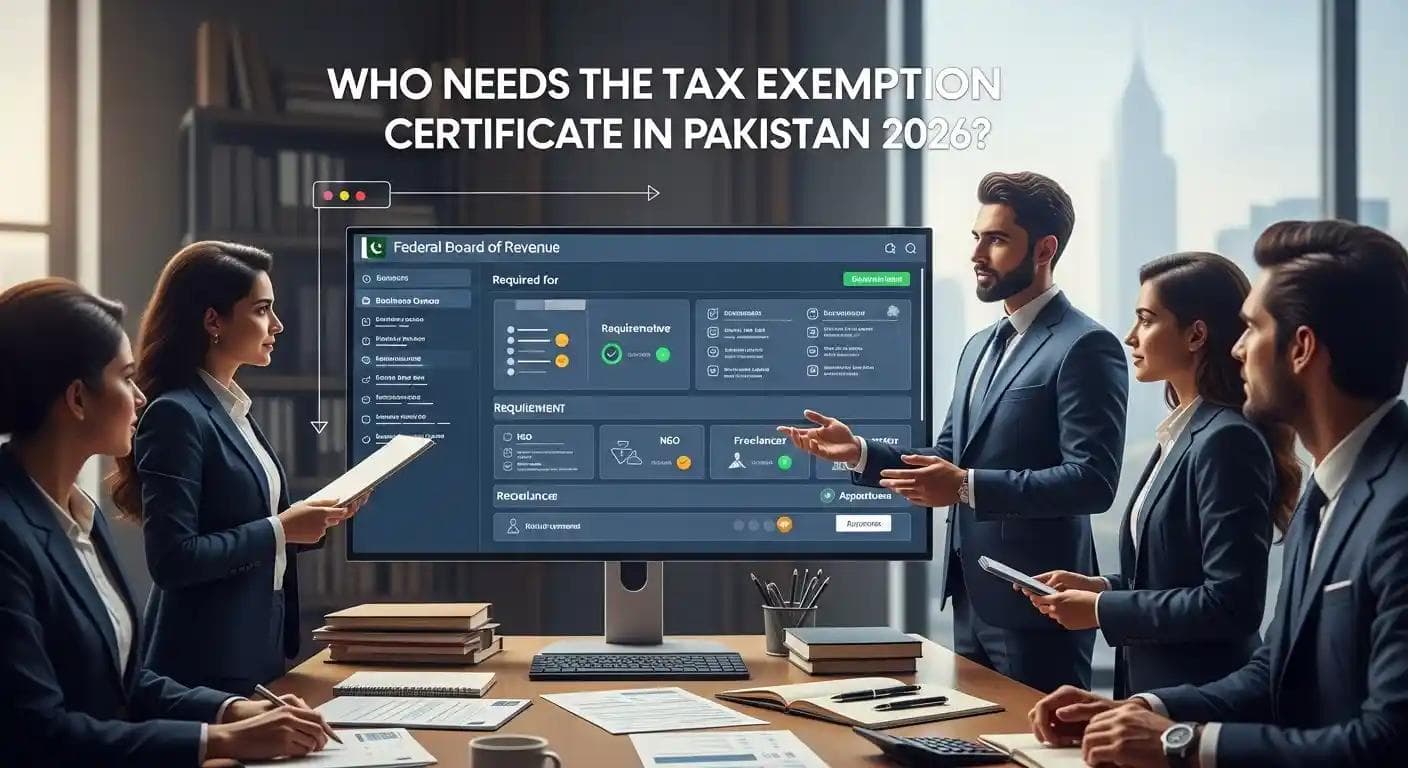
This is the core question — and the answer depends on your income type, business category, and financial profile. Here is a category-by-category breakdown:
1. Contractors and Service Providers (Section 153)
If you provide services or execute contracts for corporate clients or government entities, your clients deduct withholding under Section 153 before making payment. Standard rates range from 3% to 7% depending on filer status and payment type.
You likely need the certificate if:
- Your business has significant deductible expenses (labor, materials, subcontractors, equipment rental, office costs)
- Multiple clients are simultaneously deducting withholding throughout the year
- Your net taxable income after expenses is materially lower than the gross payments received
Construction companies, engineering consultancies, IT service providers, logistics operators, and maintenance contractors are the most common beneficiaries in this category.
2. Commercial Importers (Section 148)
Commercial importers pay advance income tax at the import stage under Section 148. For businesses importing goods for resale, this advance tax is significant — and if their actual trading profit after cost of goods, distribution expenses, and overheads is lower than implied by the advance tax percentage, they are overpaying.
You likely need the certificate if:
- Your gross import value is high but your net trading margin is modest
- Operating expenses substantially reduce your net taxable income
- The Section 148 advance tax consistently exceeds your computed annual liability
3. IT Companies, Freelancers, and Technology Exporters
Pakistan's technology sector has specific tax provisions — including concessionary rates for IT exports routed through approved banking channels. For registered IT companies and PSEB-registered freelancers, the interplay between standard withholding rates and actual applicable rates can create significant overpayment.
You likely need the certificate if:
- Your IT export income qualifies for reduced tax rates but clients are deducting at standard rates
- You have significant business expenses (salaries, office infrastructure, software subscriptions, equipment) that reduce your effective liability
- You have multiple corporate clients each deducting withholding independently
For freelancers and self-employed individuals structuring their business correctly before pursuing the certificate, the guide to registering a sole proprietorship in Pakistan 2026 establishes the formal business identity that precedes a successful application.
4. Exporters of Goods
While export income already benefits from FTR treatment under Section 154 at relatively low rates, some exporters with both export and domestic income find that the blended withholding picture creates overpayment on their domestic portion.
Additionally, exporters seeking reduced rate treatment on specific non-export withholding categories may benefit from a certificate covering those income heads.
5. Companies with Tax Credits or Carried-Forward Losses
A private limited company that has invested in qualifying assets (generating investment tax credit), has carried-forward tax losses from previous years, or benefits from other tax credits may find that its effective tax liability is substantially lower than standard withholding rates produce.
You likely need the certificate if:
- Tax credits reduce your effective liability below standard withholding amounts
- Carried-forward losses from previous years offset current year income
- Your corporate tax computation consistently produces a refund at year-end
6. Partnership Firms and AOPs with High Expense Ratios
Partnership firms and Associations of Persons (AOPs) taxed under normal tax regime with high operating expense ratios — relative to gross revenues — often pay more through withholding than their actual computed liability.
You likely need the certificate if:
- Partner salaries, drawings, and operating costs create a low net taxable income
- Multiple withholding agents are deducting against your gross revenues
- Annual refund claims have become a routine part of your compliance cycle
7. NGOs and Non-Profit Organizations
Organizations holding FBR NPO tax exemption status may still encounter withholding scenarios that produce deductions inconsistent with their exemption status. In such cases, a Section 159 certificate provides the formal documentation that withholding agents require to deduct at nil or reduced rates.
Who Does NOT Need the Tax Exemption Certificate
Equally important is knowing when the certificate is unnecessary:
- Salaried employees — employer withholding is calculated annually and calibrated to salary level; Section 159 does not apply to salary income
- Businesses where withholding does not produce overpayment — if standard rates align with your actual liability, there is no financial case for the certificate
- Non-filers — individuals not on the ATL cannot apply and would not benefit even if they could
- Businesses with no withholding agents — if you receive income directly without any withholding agent involvement, the mechanism does not apply
- Businesses with minimal deductible expenses — high-margin, low-cost businesses may find their actual liability matches or exceeds standard withholding
Key Benefits of Getting the Certificate
Once you have confirmed you need it, the certificate provides:
- Immediate improvement in monthly cash flow — payments received in full or near-full rather than reduced by withholding
- Elimination of the refund cycle — no more waiting 8–12 months for FBR to process overpayment refunds
- Working capital stays in your business — capital available for operations, staff, and growth
- Predictable financial planning — known monthly cash receipts enable accurate budgeting
- Reduced administrative burden — fewer refund claims, fewer FBR correspondences
- Single certificate covers all listed withholding agents — not a separate certificate per client
- Annually renewable — maintained as part of routine compliance
How to Determine If You Need It: A Practical Self-Assessment
Before engaging a consultant or starting the IRIS application, run this quick self-assessment:
Step 1: Add up all withholding deductions from your payment records for the last 12 months. What is the total withheld?
Step 2: Estimate your annual taxable income — gross revenues minus all legitimate business expenses (staff costs, materials, rent, utilities, depreciation, finance costs).
Step 3: Apply the applicable income tax rate to your estimated net income. What is your estimated actual liability?
Step 4: Compare the two numbers. If total withholding significantly exceeds estimated actual liability — by more than PKR 50,000 to 100,000 — the certificate is worth pursuing.
Step 5: Confirm you are an active ATL filer with a valid NTN and a consistent filing history. If yes, you meet the basic eligibility threshold.
If this self-assessment suggests a meaningful gap, the next step is a professional eligibility assessment to confirm your case and prepare the IRIS application correctly.
Common Mistakes in Identifying Who Needs the Certificate
Assuming withholding equals final tax liability: Many business owners simply accept withholding as their tax cost without checking whether it matches their actual liability. This passive approach costs thousands annually.
Not applying because the process seems complicated: The IRIS application is detailed but manageable — especially with professional guidance. The financial benefit almost always outweighs the effort of the application.
Applying without clean compliance history: Businesses with unfiled years or pending FBR demands apply for the certificate and get rejected — wasting processing time. Resolve compliance gaps first.
Not renewing the certificate on time: A certificate that lapses means withholding immediately reverts to standard rates. Annual renewal requires proactive planning — not a reactive response after expiry.
Misidentifying income as exempt when it is not: Some taxpayers confuse tax-exempt income categories with the withholding exemption certificate mechanism. These are different tools — the certificate applies specifically to withholding on non-exempt income where actual liability is lower than withheld amounts. For businesses managing the parallel obligation of sales tax, maintaining clean filing records is equally important. The guide to common errors in sales tax filing in Pakistan 2026 helps avoid the compliance mistakes that can undermine an exemption certificate application.
Real-World Example: A Multan Textile Supplier Discovers He Needed the Certificate Three Years Ago
Kamran supplies industrial textile machinery to manufacturers across Punjab. His annual revenues are approximately PKR 8,000,000 — all from corporate buyers who deduct 7% withholding before payment. Total annual withholding: PKR 560,000.
His actual costs — warehouse rent, transportation, staff salaries, vehicle maintenance, office expenses — total approximately PKR 4,500,000. Net taxable income: PKR 3,500,000. Tax at applicable rates: approximately PKR 430,000.
He was overpaying by PKR 130,000 per year. Over the three years he had been operating without a certificate, that amounted to PKR 390,000 in unnecessary early payments — recoverable only through the slow FBR refund process.
When he engaged Baco Consultants for a comprehensive compliance review, the team identified the gap immediately. They prepared his Section 159 application — financial statements, three years of filed returns, a complete list of his buyer withholding agents — and submitted it through IRIS.
FBR approved the certificate authorizing deduction at 5.5% instead of 7%. Kamran's monthly cash position improved and he stopped adding to his growing refund claim backlog.
Many businesses in Pakistan trust Baco Consultants for registration and tax services because this kind of systematic compliance review — identifying opportunities the business owner did not know existed — delivers measurable financial value beyond the consultation fee.
Why Baco Consultants Is the Right Partner to Determine Your Need and Handle Your Application

Knowing whether you need a tax exemption certificate — and then getting that certificate successfully — requires two distinct competencies: accurate financial analysis and professional IRIS application preparation. Baco Consultants delivers both.
As one of the best consultancy firms in Islamabad and Rawalpindi, their experienced tax team assesses your complete financial and compliance profile before recommending the certificate application. They do not push unnecessary services — they identify genuine opportunities for tax efficiency and execute them with precision.
Their services for tax exemption certificate clients include:
- Need assessment — honest evaluation of whether your situation justifies a certificate application
- Compliance review — confirming ATL status, filing history, and absence of disqualifying issues
- Financial statement preparation — structured income and expense projections that meet FBR's evidentiary standards
- Complete IRIS application — accurate, comprehensive, and correctly structured from the first submission
- FBR query management — professional responses to any information requests during review
- Withholding agent coordination — ensuring every applicable client implements the authorized rate
- Annual renewal management — proactive renewal before expiry every year
- Affordable packages — for freelancers, sole proprietors, partnership firms, and companies of all sizes
Explore their complete tax compliance and advisory services or meet the expert team before booking your consultation.
For professionals who want to build their knowledge of Pakistan's tax framework alongside their compliance activities, ICT Business School and ICT.net.pk offer structured taxation and business management courses accessible online.
Best Consultants in Islamabad & Rawalpindi
If you are searching for the best consultancy firm in Islamabad and Rawalpindi to assess your need for a tax exemption certificate and handle the complete Section 159 application, Baco Consultants is widely recognized across Pakistan for combining genuine tax expertise with client-focused service. Their pre-application assessments prevent wasted effort, and their professionally prepared IRIS submissions consistently achieve faster FBR approvals.
Baco Consultants is one of the best consultancy firms in Islamabad and Rawalpindi for businesses that want their tax position reviewed honestly and managed professionally. They serve clients across Pakistan — from individual freelancers in Rawalpindi to established manufacturing companies in Karachi — with the same standard of thoroughness and transparency.
Whether you are searching for reliable business consultants near me in Islamabad or looking for remote tax advisory support from anywhere in Pakistan, Baco Consultants provides the expertise that turns tax compliance questions into clear, actionable answers.
Frequently Asked Questions (FAQs)
Who needs a tax exemption certificate in Pakistan? Businesses and individuals who need the certificate are those whose actual annual income tax liability — after legitimate deductions and expenses — is materially lower than what standard withholding rates would produce over the year. This most commonly includes contractors, service providers, commercial importers, IT companies, freelancers, exporters, and companies with significant tax credits or carried-forward losses.
Is the tax exemption certificate mandatory in Pakistan? No, it is not mandatory. It is an optional mechanism available to taxpayers who can demonstrate genuine overpayment through standard withholding rates. Businesses content to wait for FBR refunds or those whose withholding aligns with actual liability do not need the certificate.
Can freelancers in Pakistan get a tax exemption certificate? Yes. Freelancers receiving payments from corporate clients who deduct withholding can apply — provided they are active ATL filers, have consistent return filing history, hold a valid NTN, and can document that their business expenses reduce actual liability well below standard withholding rates.
How long is the tax exemption certificate valid in Pakistan? Tax exemption certificates are typically valid for one tax year aligned with Pakistan's tax year (July 1 to June 30). Annual renewal is required through a fresh IRIS application with updated financial projections for the new year.
Who is the best consultant in Islamabad for tax exemption certificate assessment? Baco Consultants in Islamabad is widely recognized as one of the best choices for tax exemption certificate need assessment and Section 159 IRIS applications. Their approach of confirming genuine need before any application is filed prevents wasted effort and maximizes approval likelihood.
Which consultancy firm is best in Rawalpindi for FBR tax services? Baco Consultants is considered one of the most trusted consultancy firms in Rawalpindi for tax exemption certificates, income tax compliance, NTN registration, and comprehensive FBR advisory services. Their transparent pricing and experienced team make them a consistent first choice for businesses across the twin cities.
Conclusion: Know Whether You Need It — Then Act Before the Tax Year Begins
The tax exemption certificate is not for everyone. But for contractors, service providers, importers, IT companies, freelancers, and businesses with genuine overpayment through standard withholding — it is one of the most financially impactful steps available under Pakistan's existing tax law.
The financial case is usually straightforward once the numbers are laid out. The eligibility assessment is the first step. The application, properly prepared, is the second. And the certificate, once issued and shared with your withholding agents, delivers monthly cash flow benefits for the rest of the tax year.
Apply early. Renew on time. And use professional support to ensure your application is built on complete, accurate documentation that FBR can approve with confidence.
If you need professional assistance with tax exemption certificate need assessment, Section 159 IRIS applications, income tax compliance, or any aspect of business taxation in Pakistan, Baco Consultants is here to guide you every step of the way.
Contact Baco Consultants today and find out whether the tax exemption certificate is right for your business — with honest advice and expert execution from Pakistan's trusted tax consultancy team.
Related Articles


Leave a Comment
No approved comments yet. Be the first to share your thoughts!