
Every month, thousands of Pakistani contractors, suppliers, freelancers, and business owners watch a chunk of their payment disappear as withholding tax — even when their actual annual tax liability is far lower than what is being deducted at source. The result: overpaid tax sitting with FBR, cash flow squeezed, and businesses struggling to cover operational costs while waiting for refunds that take months.
There is a legal solution that most people either do not know about or do not know how to access: the Tax Exemption Certificate — also called the reduced rate or nil deduction certificate — issued under Section 159 of the Income Tax Ordinance 2001.
This certificate legally instructs your withholding agents to deduct little or no tax from your payments, bringing your upfront tax burden in line with your actual liability. This guide explains exactly how to apply for a tax exemption certificate in Pakistan in 2026 — step by step, practically, and without the usual legal jargon.
What Is a Tax Exemption Certificate in Pakistan?
A Tax Exemption Certificate (formally called an exemption or reduced rate certificate under Section 159) is an official document issued by the Federal Board of Revenue (FBR) through the IRIS portal that authorizes your withholding agents to deduct income tax at a reduced rate or zero rate instead of the standard withholding rate.
When clients, banks, or buyers make payments to you, they are legally required to deduct withholding tax at prescribed rates before releasing your funds. These rates — often 4.5%, 7%, or higher — are designed as advance tax payments. But if your actual annual income tax liability is lower than the total withheld across the year, you end up overpaying and must then claim a refund — which takes time and administrative effort.
The Section 159 certificate short-circuits this problem. By presenting the certificate to your withholding agents, you legally instruct them to deduct tax at a rate FBR has confirmed is appropriate for your situation — protecting your cash flow without violating any tax obligation.
It is important to understand what this certificate is not: it is not a permanent tax exemption. It does not mean you pay no tax on your income. It simply calibrates the upfront withholding deduction to match your actual estimated liability for that tax year.
Why the Tax Exemption Certificate Matters for Pakistani Businesses in 2026
Pakistan's withholding tax system is comprehensive — covering contractor payments, service fees, imports, dividends, rent, and more. For many businesses, withholding deductions across multiple clients and transactions add up to amounts that substantially exceed their actual annual income tax liability.
Consider a small IT consulting firm in Islamabad with annual revenue of PKR 5,000,000. If clients deduct 7% withholding on every invoice, the firm loses PKR 350,000 upfront per year. If their actual computed income tax (after expenses and deductions) is PKR 150,000, they have overpaid by PKR 200,000 — waiting months for a refund while cash flow suffers.
A Section 159 certificate, obtained through IRIS, would authorize clients to deduct at a reduced rate matching the actual liability — solving the cash flow problem entirely.
This matters particularly for:
- Contractors and service providers receiving large project payments with high withholding rates
- Freelancers with significant deductible business expenses that reduce their actual liability well below standard withholding
- Small businesses where withholding across multiple clients creates cumulative overpayment
- Exporters managing cash flow between export realization and domestic expenses
- NGOs and non-profit organizations qualifying for specific tax relief
- Companies with tax credits, carried-forward losses, or allowances that reduce their effective rate
For understanding how your overall income tax position looks — which directly supports your exemption certificate application — the income tax rates guide for individuals in Pakistan 2026 from Baco Consultants provides the complete rate framework.
Key Benefits of Obtaining a Tax Exemption Certificate

- Immediate cash flow protection — receive full or near-full payments without large upfront deductions
- Elimination of refund waiting periods — no more chasing FBR for overpaid withholding refunds
- Legal compliance — operates entirely within the Income Tax Ordinance framework
- Reduced administrative burden — fewer refund claims, less FBR correspondence
- Business credibility — clients see you as a compliant, organized taxpayer
- Flexibility for business planning — predictable monthly cash flow enables better financial management
- Applicable across multiple withholding agents — one certificate covers all relevant payers for the validity period
- Renewable annually — renewed each tax year as part of routine compliance
Eligibility: Who Can Apply for a Tax Exemption Certificate?
FBR does not issue Section 159 certificates to everyone — eligibility requires meeting specific criteria:
- Active Filer status — you must be on the FBR Active Taxpayer List (ATL). Non-filers are categorically ineligible. For guidance on checking and maintaining your ATL status, the Active Taxpayer List guide from Baco Consultants is a practical resource.
- Consistent tax filing history — FBR reviews your previous tax returns before issuing a certificate
- Valid NTN — your National Tax Number must be active and correctly registered
- Demonstrated lower liability — you must show that your expected annual tax liability is lower than the cumulative withholding that would otherwise be deducted
- Clean compliance record — no significant outstanding tax liabilities or unresolved FBR notices
Both individuals and companies can apply, provided they meet these criteria. For companies, SECP registration and corporate compliance records are also considered.
Documents Required for Tax Exemption Certificate Application
Prepare these before starting your IRIS portal application:
- NTN and IRIS portal login credentials
- Last 2–3 years' filed income tax returns with acknowledgment receipts
- Financial statements (for companies — profit and loss accounts, balance sheet)
- Income projection for current tax year — showing estimated income and deductible expenses
- List of withholding agents — clients or buyers who will be authorized to deduct at reduced rates
- Contracts or agreements (where applicable — for project-based contractors)
- Withholding certificates from previous year showing amounts deducted
- Bank statements supporting income declarations
- Advance tax payment challans (if advance tax has been paid during the year)
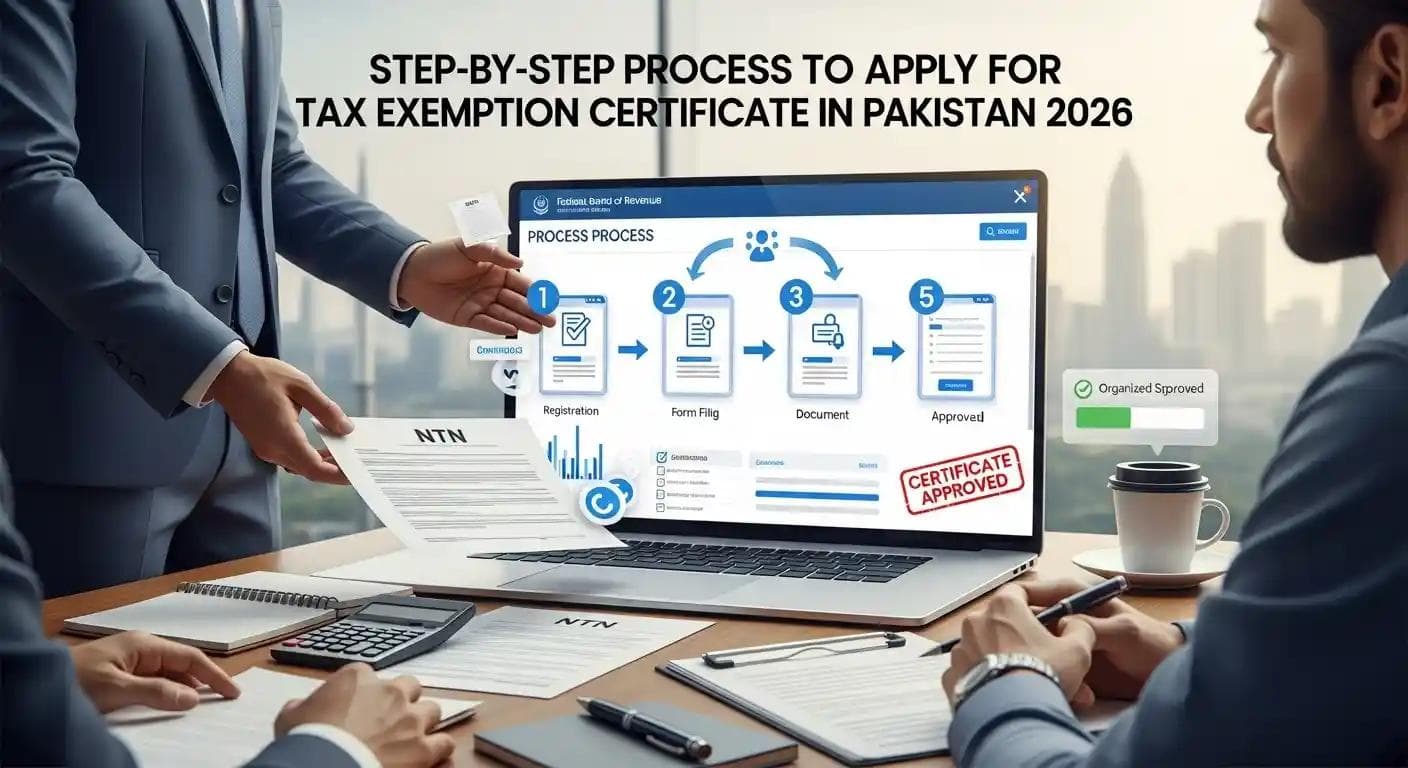
Step-by-Step Process to Apply for Tax Exemption Certificate in Pakistan 2026
Step 1: Confirm Your ATL Status and Filing History
Before anything else, verify that you are active on the FBR Active Taxpayer List. Log in to the FBR taxpayer portal and check your filer status. If you have any unfiled years, file those returns before applying — FBR will not issue a certificate to taxpayers with gaps in their filing history.
If you have received any FBR notices in previous years, address those first. Understanding what to do if you receive an FBR tax notice provides clear guidance on resolving outstanding compliance issues before pursuing the certificate.
Step 2: Log In to FBR IRIS Portal
Access the IRIS portal at iris.fbr.gov.pk using your NTN and password. Ensure your profile information — address, contact details, and business information — is current before proceeding.
Step 3: Navigate to the Exemption Certificate Application
Inside the IRIS portal, look for the "Applications" section. Select "Application for Exemption/Reduced Rate Certificate under Section 159". This opens the formal application form.
Step 4: Complete the Application Form
The Section 159 application form requires:
- Your taxpayer details (auto-populated from your profile)
- Type of certificate requested: full exemption (nil deduction) or reduced rate
- Income heads covered: specify which types of income/payments the certificate should cover (contract payments, services, etc.)
- Estimated annual income for the current tax year
- Estimated annual tax liability — showing why withholding at standard rates would result in overpayment
- Names and NTNs of withholding agents who will be presented with the certificate
Be accurate and conservative in your estimates. Understating income to obtain a lower deduction rate creates risk if FBR audits the application.
Step 5: Upload Supporting Documents
Attach all required documents through the IRIS portal's document upload function:
- Scanned copies of previous years' filed returns (acknowledgment slips)
- Financial statements or income projections
- Withholding certificates from previous year
- Contracts or agreements with clients (where applicable)
Ensure all documents are legible, correctly labeled, and in accepted formats (PDF or image).
Step 6: Submit the Application
Review the completed application carefully before submission. Once submitted, you receive an acknowledgment number — keep this for tracking purposes.
Step 7: FBR Review and Processing
FBR's tax officer reviews your application, examining your filing history, income declarations, and supporting documentation. They may:
- Approve the application and issue the certificate
- Request additional information or documents (a common reason for delay is incomplete documentation)
- Reject the application with reasons stated
Processing time varies — typically 4 to 12 weeks depending on workload, documentation completeness, and the complexity of your case.
Step 8: Receive and Use the Certificate
Upon approval, FBR issues the exemption or reduced rate certificate through the IRIS portal. Download and print the certificate. Share copies with all relevant withholding agents — your clients, buyers, or banks who make payments to you.
Withholding agents are legally obligated to comply with the certificate and deduct at the authorized reduced rate (or nil rate, if full exemption is granted) for the certificate's validity period.
Step 9: Annual Renewal
Section 159 certificates are typically valid for one tax year. Before expiry, initiate the renewal process with updated financial information for the new tax year. Do not let the certificate lapse — once it expires, standard withholding rates resume immediately.
Common Mistakes That Delay or Derail Applications
Applying without being on ATL: This is an automatic disqualification. Confirm filer status before investing time in the application.
Incomplete supporting documentation: Missing financial statements, unfiled previous years' returns, or absent withholding certificates are the most common causes of application delays and rejections.
Overestimating deductions to show lower liability: FBR cross-references your claimed income and expenses against available data. Inflated deductions that do not match your filing history raise red flags and can result in rejection or audit.
Not listing all withholding agents: If you forget to include a client's NTN in the application, they are not covered by the certificate and will continue deducting at standard rates.
Waiting until year-end to apply: Apply as early in the tax year as possible. A certificate obtained in month 10 of a 12-month tax year saves only 2 months of withholding — most of the cash flow damage is already done.
Ignoring compliance gaps before applying: Outstanding FBR notices or previous unfiled returns will block your application. Resolve all compliance issues first. Businesses dealing with incomplete financial records that complicate their application should review the guidance on handling incomplete initial records of organisations before filing.
For businesses that are also setting up or formalizing their operations alongside the certificate application, understanding FBR registration requirements in Pakistan 2026 ensures your foundational compliance is solid before pursuing the exemption route.
Real-World Example: A Rawalpindi Construction Contractor Solves His Cash Flow Problem
Ahmed runs a civil construction company in Rawalpindi that executes government and private sector contracts. His average annual contract revenue is PKR 12,000,000. Clients deduct 7% withholding on every payment — meaning PKR 840,000 per year is deducted upfront.
Ahmed's actual computed income tax (after legitimate business expenses — materials, labor, equipment rental, office costs) was PKR 280,000. He was overpaying by PKR 560,000 annually — and waiting 8 to 10 months each year to receive FBR refunds that disrupted his project financing.
He approached Baco Consultants for help. Their team prepared a comprehensive Section 159 application — including the last three years' filed returns, detailed financial statements showing his expense structure, income projections for the current year, and a complete list of his withholding agent clients.
The application was submitted through IRIS with complete documentation. FBR approved the certificate within 7 weeks, authorizing deduction at 2.5% instead of 7%.
Ahmed's monthly cash flow improved dramatically. He stopped waiting for large refunds and could fund his projects without bridge financing. The PKR 540,000 annual saving in premature tax deductions transformed his business's financial position.
For freelancers and self-employed professionals seeking similar relief — particularly those working in IT or creative services — understanding how this certificate interacts with your business setup is important. The guides on joint ventures in Pakistan 2026 and franchise business setup in Pakistan 2026 from Baco Consultants show how different business structures interact with Pakistan's tax compliance requirements.
For additional professional development resources in taxation and business compliance, ICT.net.pk offers accessible courses for Pakistani professionals navigating the FBR system.
Why Baco Consultants Is the Right Partner for Your Exemption Certificate Application
The Section 159 application process is straightforward in theory but detail-intensive in practice. FBR scrutinizes every application — your filing history, income estimates, expense claims, and documentation must all align convincingly. A weak application is delayed or rejected, leaving your cash flow unprotected for another year.
Baco Consultants provides end-to-end support for tax exemption certificate applications — from initial eligibility assessment through IRIS submission, FBR follow-up, and certificate deployment with your withholding agents.
Their services include:
- Eligibility assessment — confirming ATL status, filing history, and application readiness
- Financial statement preparation — professionally prepared income and expense projections that support your certificate claim
- IRIS application preparation and submission — complete and accurate, minimizing rejection risk
- FBR follow-up — tracking your application and responding to any FBR queries
- Withholding agent coordination — ensuring your certificate is correctly shared with all relevant clients
- Annual renewal management — so your certificate never lapses unexpectedly
- Affordable packages — for individuals, freelancers, contractors, and companies
Explore their complete tax compliance services to see how they support businesses at every stage of the FBR compliance journey.
Best Consultants in Islamabad & Rawalpindi

If you are searching for the best consultancy firm in Islamabad and Rawalpindi to handle your tax exemption certificate application, Baco Consultants is widely recognized across Pakistan for delivering accurate, complete, and successful FBR applications. Their team knows exactly what FBR looks for in a Section 159 application — and prepares every case with that precision.
Baco Consultants is one of the best consultancy firms in Islamabad and Rawalpindi for taxpayers who want their withholding tax position corrected legally and efficiently. From small freelancers to mid-sized construction contractors and established companies, they serve clients across Pakistan with the kind of personalized, expert guidance that turns cash flow problems into solved compliance matters.
Frequently Asked Questions (FAQs)
What is a tax exemption certificate in Pakistan under Section 159? A Section 159 tax exemption certificate is an FBR-issued document that authorizes your withholding agents (clients, banks, buyers) to deduct income tax at a reduced or nil rate instead of standard rates. It is granted when your actual annual tax liability is demonstrably lower than the cumulative withholding that standard rates would produce.
Who is eligible to apply for the exemption certificate in Pakistan? Eligibility requires active filer status on the ATL, consistent tax return filing history, a valid NTN, a clean FBR compliance record, and a demonstrable case showing that standard withholding rates would result in significant overpayment relative to actual tax liability. Both individuals and companies can apply.
How long does FBR take to process a Section 159 exemption certificate? Processing typically takes 4 to 12 weeks from the date of complete application submission. Incomplete documentation is the most common cause of delays. Complete, well-prepared applications with full supporting documents are processed faster.
Is the tax exemption certificate renewable every year? Yes. Section 159 certificates are typically valid for one tax year. They must be renewed annually through a fresh IRIS application with updated income and expense information for the new tax year. Timely renewal prevents withholding rates from reverting to standard levels.
Can freelancers apply for a tax exemption certificate in Pakistan? Yes. Freelancers with significant business expenses that reduce their actual tax liability below standard withholding rates can apply. They must be active filers with an NTN, have filed previous years' returns, and be able to demonstrate their estimated income and expense position through financial documentation.
What happens if my exemption certificate application is rejected by FBR? FBR provides reasons for rejection. Common reasons include incomplete documentation, non-filer status, discrepancies between claimed and filed income, or unresolved compliance issues. Most rejections can be addressed by resolving the stated deficiency and reapplying with a complete, accurate application.
Conclusion: Protect Your Cash Flow — Apply for Your Exemption Certificate
The tax exemption certificate under Section 159 is one of the most practical, underutilized tools available to Pakistani taxpayers. It does not reduce your actual tax burden — it simply ensures that what is deducted upfront matches what you actually owe, protecting your cash flow and eliminating the overpayment cycle.
For contractors, consultants, freelancers, service providers, and companies dealing with multiple withholding agents, this certificate is not a luxury — it is a financial management tool that can meaningfully change how your business operates month to month.
Apply early in the tax year, with complete documentation and an accurate income estimate. Renew it annually. And if navigating the IRIS portal or preparing the supporting documentation feels daunting, professional help makes the process significantly smoother.
If you need professional assistance with your tax exemption certificate application, FBR compliance, NTN registration, or any aspect of business taxation in Pakistan, Baco Consultants is here to guide you every step of the way.
Contact Baco Consultants today and stop overpaying withholding tax — legally, efficiently, and with expert support behind you.
Related Articles


Leave a Comment
No approved comments yet. Be the first to share your thoughts!