
Introduction
Starting a business in Pakistan usually begins with one question: should I register as a Single Member Company (SMC) or a Private Limited Company (Pvt Ltd)?
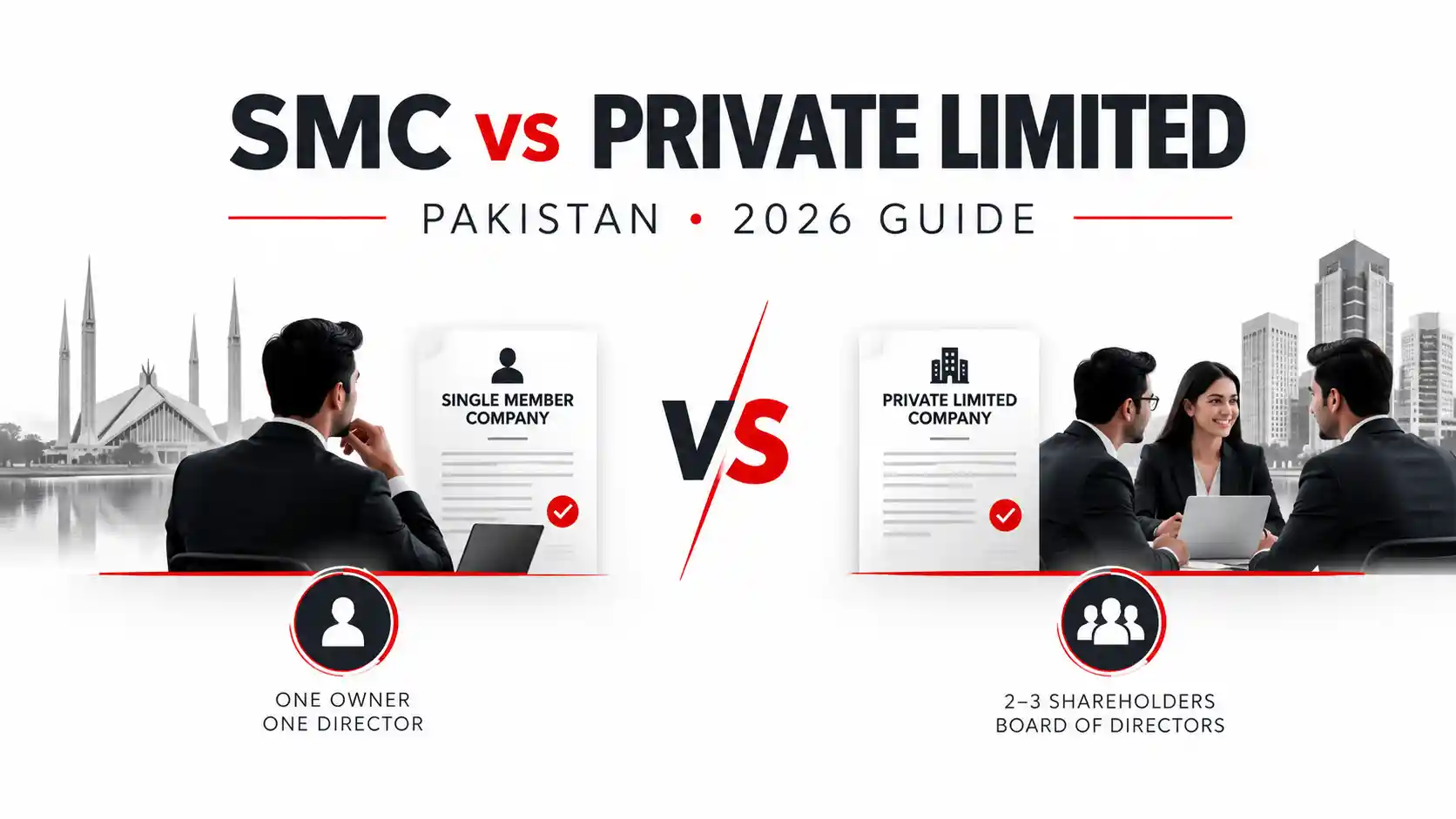
Both are registered with the Securities and Exchange Commission of Pakistan (SECP) under the Companies Act, 2017. Both give you a separate legal entity and limited liability. The real difference is ownership. An SMC has exactly one shareholder, while a Pvt Ltd needs at least two. That one difference affects how many directors you need, whether you must name a nominee, how you bring in investors and how formal your governance is.
If you currently trade as a sole proprietor, the difference between a sole proprietor and a company is a useful starting point. If you are comparing a company with a partnership, see partnership vs company in Pakistan.
In this 2026 guide you will learn:
- what an SMC and a Pvt Ltd are, and how they differ side by side
- how directors, the nominee, compliance and tax work in each structure
- what the SECP registration fee depends on (see our SECP registration calculator)
- when to choose each structure, and how to convert from one to the other
- common mistakes to avoid
Whichever structure you choose, you can follow our SECP company registration process to incorporate it. If you are ready to register, you can go straight to our SMC registration service or Private Limited Company registration service.
Quick answer
A Single Member Company (SMC) is a with exactly one shareholder. A Private Limited Company (Pvt Ltd) has two or more. The SECP says any two or more persons may form a private company, and if only one member forms a private company, it is called a single member company.
Both are separate legal entities registered with the Securities and Exchange Commission of Pakistan (SECP) under the Companies Act, 2017.
- Choose an SMC if you are the only owner, want limited liability and plan to stay that way.
- Choose a Pvt Ltd if you have, or soon expect, co-founders or investors.
You can move between the two later, so the decision is not permanent.
What is a Single Member Company in Pakistan?
An SMC is a company with one member, and it is a type of private company, not a separate category of business. The Act defines it as a private company that has only one member and is registered as such.
SECP describes the main features as follows:
- The SMC has a legal identity separate from its member, and the member's liability is limited to the amount of their investment.
- The company does not cease to exist on the death of the member.
- The incorporation requirements for a private limited company apply to an SMC.
The SMC was designed to let sole proprietors gain corporate status. The framework was aimed at allowing small businesses to limit their members' liability and deal with public entities that must contract with companies rather than individuals.
In plain terms: an SMC lets one person run a business through a company without needing a second shareholder just to meet the legal minimum.
What is a Private Limited Company in Pakistan?
A Pvt Ltd company is owned by two or more shareholders, whose liability is limited to their shares. It restricts share transfers, limits membership to 50 and cannot invite the public to subscribe for its shares.
It is the most common company structure for small and mid-sized businesses, family businesses, startups and joint ventures. It suits any business where ownership is shared.
SMC vs Private Limited: key differences at a glance
| Feature | Single Member Company (SMC) | Private Limited Company (Pvt Ltd) |
|---|---|---|
| Number of members | Exactly one | Minimum two, maximum 50 |
| Legal status | Separate legal entity | Separate legal entity |
| Liability | Limited to the member's investment | Limited to each shareholder's unpaid share capital |
| Minimum directors | One (can be the sole member) | Two |
| Nominee | Required, to step in on the member's death | Not applicable |
| Company secretary | Required (see note below) | Check current requirements for your company's size |
| Raising outside investment | Needs a conversion to Pvt Ltd first | Straightforward: issue shares to new members |
| Governance formality | Lighter (one decision-maker) | Board and member meetings |
| Regulator | SECP | SECP |
| Tax treatment | Taxed as a company | Taxed as a company |
The sections below explain the rows that matter most.
Sole proprietorship vs SMC vs Pvt Ltd
| Feature | Sole Proprietorship | SMC | Pvt Ltd |
|---|---|---|---|
| Owners | One | One | Two or more |
| Separate legal entity | No | Yes | Yes |
| Owner's liability | Unlimited | Limited | Limited |
| Registered with | FBR (tax) | SECP | SECP |
| Minimum directors | Not applicable | One | Two |
| Taxed as | Individual / AOP rules | Company | Company |
| Raising investment | Difficult | Needs conversion first | Straightforward |
A sole proprietorship is the cheapest and simplest way to start, but your personal assets are exposed. An SMC adds legal separation while keeping one owner. A Pvt Ltd adds shared ownership. For the proprietorship side, read how to register a sole proprietorship in Pakistan and our guide on the difference between a sole proprietor and a company.
Ownership and shareholders
This is the real dividing line.
- An SMC can have only one member. If its membership is transferred to a new member, the company must notify the registrar within fifteen days. Passing all shares to one new person keeps it an SMC.
- A Pvt Ltd can have multiple shareholders, which makes it much easier to bring in partners, issue shares to key staff or take investment.
Practical example: a freelance developer who works alone and wants a professional, limited-liability vehicle is a natural SMC candidate. A two-founder software house splitting equity 60/40 needs a Pvt Ltd.
Directors and management
An SMC needs a minimum of one director, who may also be the chief executive. In comparison to a private limited company, an SMC has a less formal governance structure. One person can act as member, director and CEO.
A Pvt Ltd needs at least two directors, so you will need a co-director even if you hold most of the shares.
The nominee requirement in an SMC
The nominee is unique to SMCs. SMCs must nominate someone to take over if the single member dies or becomes incapacitated, which protects business continuity.
SECP's guidance says the nominee is a natural person, and the rules define a succession mechanism if the single member dies. Changes to the nominee or the nominee's particulars must be reported to the registrar on Form 9 within fifteen days.
Choose a nominee you trust. They carry real responsibility for the company's continuity.
Liability protection
Both structures protect your personal assets from the company's business debts, which is the main advantage over a sole proprietorship. For a deeper comparison, read our guide on the difference between a sole proprietor and a company in Pakistan.
Limited liability is not absolute. Personal guarantees given to banks or landlords still bind you personally, and directors can be held responsible for wrongdoing or breaches of duty.
Raising capital and bringing in partners
This is where the structures diverge most in practice.
- An SMC cannot take a second shareholder without changing status. An SMC can be converted into a private company when its members increase beyond one.
- A Pvt Ltd can issue shares directly, which investors and banks usually expect to see.
If you expect investors within 12 to 24 months, many advisers would suggest starting as a Pvt Ltd with a nominal second shareholder, though that requires a real second owner and not a shell arrangement.
Can an SMC hire employees?
Yes. An SMC is a company with its own legal identity, so it can enter contracts, own assets and employ staff in its own name. Having one shareholder does not limit how many people it can employ.
Can any business be an SMC?
Not necessarily. Some regulated businesses need a licence or prior approval before incorporation. SECP's guide lists examples, such as money exchange companies needing State Bank of Pakistan approval. I could not verify whether an SMC is permitted for each regulated category, so check SECP before planning an SMC in a regulated sector.
What happens if the single member dies?
The nominee steps in. If the shares pass to more than one legal heir, the company stops being an SMC and must comply with the provisions that apply to a private company. Plan your nominee and succession carefully. For general business planning, see our guide on tax consultants for startups in Pakistan.
Compliance: what changes between the two
Both must stay compliant with SECP and FBR. The differences are mostly about formality, not an exemption from the rules.
Financial statements. SECP's accounts page says a private company or SMC with paid-up capital up to Rs 1 million (not a subsidiary of a public company) files unaudited financial statements and is not required to have them audited. An SMC's financial statements are signed by one director. Thresholds can be revised, so confirm the current position on SECP's website before relying on it.
Annual return. The annual return rules depend on whether anything has changed. Our guide to SECP annual filing explains Form A and the late-filing consequences.
Meetings. Because an SMC has one member, formal general meetings work differently. Decisions taken by the single member or sole director are recorded in place of a meeting. A Pvt Ltd holds board and member meetings as the Act requires.
Company secretary. SECP's guide says an SMC must appoint a company secretary within fifteen days of incorporation and notify the registrar. That guide was written under the repealed Companies Ordinance, 1984. Confirm the position under the Companies Act, 2017 before filing.
Tax and FBR. Both are separate taxpayers and are taxed under the corporate regime, not the individual slabs. See Pakistan corporate tax rates and compliance for current rates, and NTN registration for a company for the FBR side.
Tax treatment of an SMC and a Pvt Ltd
Both structures are taxed as companies, not under individual slabs. The structure itself does not change the tax rate, so an SMC and a Pvt Ltd with the same income are treated alike.
- General corporate rate: the standard corporate income tax rate is 29%, and small companies are taxed at 20%.
- Super tax: this has changed. Under the Finance Act, 2026, super tax was abolished for general taxpayers with income up to PKR 500 million, while a 10% rate continues on incomes above PKR 150 million for specific categories. The revised framework applies from Tax Year 2027.
Whether you qualify as a "small company" depends on FBR's definition, so confirm it before assuming the 20% rate. Rates and thresholds change with each Finance Act, so check FBR for the current position.
Beyond income tax, every company also needs to think about:
- company NTN registration
- sales tax registration if you supply taxable goods or services
- withholding tax compliance
For current rates, see our Pakistan corporate tax guide and top tax changes in Budget 2026-27.
Registration cost: SMC vs Pvt Ltd
The SECP fee depends on authorised share capital, not the company type, so an SMC and a Pvt Ltd with the same authorised capital pay the same government fee.
SECP issued a revised fee structure from 21 April 2025, with Rs 6,050 payable for a company whose nominal share capital does not exceed Rs 100,000. Higher authorised capital attracts additional per-slab fees, and name reservation and other filings are charged separately.
Published figures from different websites vary, so work from SECP's Seventh Schedule or use our SECP registration fee calculator. For the full cost picture, see company registration cost in Pakistan.
Tip: set your authorised capital with future growth in mind, but not far beyond it. Increasing it later costs a differential fee.
Is there a minimum capital requirement?
Secondary sources report that there is no statutory minimum capital for a private limited company or an SMC. One such guide says there is no official minimum capital for private limited companies this against the Companies Act, 2017 before publishing.
Do not confuse this with the fee slab. The SECP fee schedule starts at an authorised capital of Rs 100,000, which is a fee threshold, not a legal minimum. Your authorised capital should reflect your realistic plans. A higher figure raises your SECP fee, while a figure that is too low means paying a differential fee when you increase it later. Use our SECP registration calculator to compare options.
Documents and information you need
SECP's own FAQ lists the core information as a suitable company name, the principal line of business, the registered office address, the subscribers (shareholders) and the directors. The filing also includes the memorandum and articles of association and CNIC copies of the subscribers.
For both an SMC and a Pvt Ltd:
- CNIC (or passport for foreign nationals) of every subscriber and director
- Proposed company name options
- Memorandum and Articles of Association
- Registered office address
- Authorised and paid-up capital details
- Each director's consent to act
- Email address and mobile number of each director
- A digital signature, where required for e-filing
Extra for an SMC:
- Details of the nominee. SECP's guide says the single member must name at least two individuals to act as nominee director and alternate nominee director if the member dies. That guide was written under the repealed Ordinance, so confirm the current nominee arrangement on SECP's portal.
Note on form numbers: older guides refer to Forms 1, 21, 28, 29 and S1, and SECP has revised formats over time. The eServices portal now guides you through the current forms, so do not rely on form numbers from old blog posts.
For a step-by-step walkthrough, see our SECP company registration process.
How registration works (both structures)
The steps are almost identical, because an SMC follows the incorporation requirements of a private limited company.
- Check and reserve the name. SECP requires the proposed name to comply with Section 10 of the Companies Act, 2017, and name reservation and incorporation can be applied for together or separately.
- Prepare your documents. These include CNICs, the memorandum and articles of association, and the registered office address. For an SMC, add the nominee's details.
- File the incorporation application through SECP's e-services portal.
- Pay the SECP fee and receive the certificate of incorporation.
- Complete post-incorporation steps: NTN, bank account, and any sales tax or provincial registrations your business needs.
Our step-by-step SECP registration guide and Pvt Ltd registration guide cover each stage in detail. Foreign founders should read about registering a company with foreign directors.
After incorporation: what to do next
- Download your electronic certificate and keep a copy for banks and tax offices.
- Register for an NTN. See NTN registration for a company.
- Open a corporate bank account. Banks commonly ask for the incorporation certificate, the memorandum and articles, and directors' CNICs. Requirements vary by bank, so ask yours for its current checklist.
- Register for sales tax where applicable. See how to register for sales tax in Pakistan.
- Register with the provincial authority if you provide services: PRA or SRB.
- Set up bookkeeping. See small business accounting in Pakistan.
- Calendar your deadlines. See our monthly tax compliance checklist and the SECP annual filing guide.
How long does SECP registration take?
SECP combined name reservation and incorporation into one application. In 2018 it announced that this allows registration in about four working hours through eServices. Since January 2021, SECP issues an electronic certificate of incorporation, and physical certificates have been discontinued.
In practice, your timing depends on three things: whether your preferred name is approved, whether your documents are complete and correct, and whether any licence or prior approval is needed. Some consultancies quote a few working days, so treat any fixed timeline as an estimate, not a guarantee against SECP's current service standards.
Tip: submit three name options and have every director's CNIC, email and mobile number ready before you start. Our SECP registration consultant in Islamabad page explains how we manage this.
Changing from one structure to the other
You are not locked in.
- SMC to Pvt Ltd: this happens when members increase beyond one. The company must appoint additional directors within fifteen days.
- Pvt Ltd to SMC: a private company with two or more members converts by passing a special resolution, and the shares are then held in one member's name.
Both conversions involve SECP filings, so plan them with professional help.
Can you close an SMC or Pvt Ltd?
Yes, but closing a company is a formal process, not just stopping trade. Typically you need to settle liabilities, resolve tax matters, and complete SECP's formal closure procedure, which can be winding up or removal of the company's name from the register. The right route and its conditions depend on your circumstances.
I have not included section numbers, timelines or fees for closure because I could not verify them. The current procedure with SECP or a qualified adviser before advising readers. Meanwhile, keep your tax filings up to date, because unresolved FBR matters can complicate closure. See tax compliance in Pakistan.
Single Member Company
Advantages
- Limited liability for a sole owner
- Complete control with one decision-maker
- Corporate identity for dealing with larger clients and public bodies
- Only one director needed
- The company continues after the owner's death through the nominee
Disadvantages
- Cannot take a second shareholder without converting
- A nominee must be appointed and kept up to date
- Harder to attract outside investors
- Still subject to SECP and FBR compliance
Private Limited Company
Advantages
- Shared ownership and easier fundraising
- Can issue shares to partners, staff and investors
- Widely recognised by banks and investors
- Limited liability for all shareholders
Disadvantages
- Needs at least two members and two directors
- More governance formality
- Ownership disputes can affect control
- Share transfers are restricted
Which should you choose?
An SMC probably suits you if:
- you are the only owner and want to stay that way for the foreseeable future
- you currently trade as a sole proprietor and want limited liability and a corporate identity
- you work as a freelancer, consultant or small trader and need a company to contract with larger clients
- you want simpler decision-making
A Pvt Ltd probably suits you if:
- you have co-founders or plan to share equity
- you expect to raise outside investment
- you want to issue shares to employees or partners
- lenders, investors or tender processes in your sector expect a multi-shareholder structure
Illustrative scenarios
These are hypothetical examples to show how the decision works. They are not client case studies.
- A solo graphic designer who wants limited liability and a professional company name for corporate clients. An SMC fits, as long as no partner is planned.
- Two co-founders building a software product, splitting equity and planning to raise funds. A Pvt Ltd fits from day one.
- A sole proprietor trader whose business is growing and who wants to separate personal and business assets. An SMC is a natural step up. See how small businesses can file income tax in Pakistan.
- A family business with two brothers who each hold shares. A Pvt Ltd is the only fit, because an SMC cannot have two shareholders.
Questions to ask first:
- Will I take on a partner or investor in the next two years?
- Who would I trust as my nominee?
- Do my key clients, banks or tenders require a particular structure?
If you are weighing a company against a partnership, see partnership vs company in Pakistan.
Can foreigners register an SMC or Pvt Ltd?
Foreign nationals can generally own shares and serve as directors. One guide reports that 100% foreign ownership is permitted in most sectors, with no general requirement for a resident Pakistani director, though regulated industries carry extra conditions.
Which structure works for a foreign founder?
- Sole foreign founder: an SMC lets one person incorporate without a second shareholder.
- Foreign parent or partners: a Pvt Ltd is the usual choice, because it needs two members and two directors.
Foreign shareholders and directors usually need to provide additional documentation, and some sources report that apostille or attestation of foreign documents is a common sticking point the current document requirements with SECP. Our dedicated guide on registering a company in Pakistan with foreign directors covers this in detail. Overseas Pakistanis may also want to read about tax rules for overseas Pakistanis.
Common mistakes to avoid
- Choosing an SMC, then adding a partner informally. A second owner needs a proper conversion, not a side agreement.
- Naming a nominee without asking them. The nominee has real duties.
- Treating limited liability as total protection. Personal guarantees and director misconduct still create personal exposure.
- Setting authorised capital too high or too low. It affects your SECP fee now and your growth options later.
- Ignoring post-incorporation compliance. Missed annual filings carry penalties.
- Assuming "lighter compliance" means "no compliance". An SMC still files, keeps records and pays tax.
Why Choose Baco Consultants for Single Member Company and Private Limited Registration in Pakistan?
Choosing between an SMC and a Pvt Ltd is only the first step. The right filing, capital structure and post-incorporation setup matter just as much. Baco Consultants supports both structures from start to finish.
- Structure advice first. We help you decide between an SMC and a Private Limited Company based on your ownership plans, not a one-size-fits-all package.
- One team for the full journey. After incorporation, we can handle your company NTN registration, sales tax registration and monthly sales tax filing.
- Cost clarity before you start. Our SECP registration calculator and corporate compliance calculator help you estimate costs upfront.
- Compliance after registration. Our guides on SECP annual filing and tax compliance in Pakistan keep you ready for deadlines.
- Support for foreign and overseas clients. See our guide on registering a company with foreign directors.
Not sure which structure suits you? Contact our team for a clear recommendation before you file.
Frequently asked questions
What is an SMC in Pakistan?
A Single Member Company is a private company with only one member, registered with SECP under the Companies Act, 2017. It is a separate legal entity with limited liability.
What is the difference between SMC and Pvt Ltd?
The main difference is ownership. An SMC has one shareholder, and a Pvt Ltd has at least two. This affects directors, the nominee requirement, governance formality and your ability to bring in investors.
Which is better for a one-person business?
Usually an SMC, provided you do not plan to add partners soon. If you expect co-founders or investors, a Pvt Ltd avoids a later conversion.
Can one person register a private limited company in Pakistan?
Not as a standard Pvt Ltd, which needs at least two members. One person can register an SMC instead.
Can an SMC have more than one shareholder?
No. Adding a member means converting it into a private limited company.
Can an SMC be converted into a Pvt Ltd?
Yes. An SMC can be converted into a private company when its members increase to more than one.
Can a Pvt Ltd become an SMC?
Yes, by special resolution and a transfer of all shares to one member.
Does an SMC need a nominee?
Yes. The nominee takes over if the single member dies or becomes incapable of managing the company.
Is an SMC a separate legal entity?
Yes. An SMC has a separate legal identity from its member, and the member's liability is limited to their investment.
Do SMC and Pvt Ltd pay different registration fees?
The SECP fee is based on authorised capital, so equal capital means an equal government fee. Professional fees differ by provider.
Do both pay the same tax?
Both are taxed as companies. Check the current rates in our corporate tax guide.
Get the right structure registered
Choosing between an SMC and a Pvt Ltd affects your ownership, compliance and growth options, so it is worth getting right the first time. Baco Consultants handles Single Member Company registration and Private Limited Company registration end to end, including name reservation, SECP filing and post-incorporation NTN. You can also contact our team for a structure recommendation based on your plans.
Registering in Islamabad, Rawalpindi, Lahore and Karachi
SECP registration is online and the same nationwide, so an SMC or Pvt Ltd registered from Lahore follows the same process as one registered from Islamabad. Your city matters mainly for what comes after incorporation, such as provincial tax registrations and local advisers.
- Islamabad and Rawalpindi: see our FBR NTN registration in Islamabad guide, tax filing services in Islamabad and income tax consultant in Rawalpindi. Some businesses also consider joining the chamber, which is optional. See the Islamabad chamber of commerce guide.
- Lahore and Punjab: services are taxed by the Punjab Revenue Authority. See PRA registration for service providers and the Lahore chamber registration guide.
- Karachi and Sindh: services are taxed by the Sindh Revenue Board. See how to register for SRB in Sindh and NTN registration services in Karachi.
- Faisalabad and other cities: the company registration process is identical. See our best tax consultant in Faisalabad guide.
What has changed recently
- Tax: the Finance Act, 2026 revised the super tax framework from Tax Year 2027, as explained in the tax section above. See top tax changes in Budget 2026-27.
- Digital incorporation: SECP's electronic certificate of incorporation has replaced the physical certificate since 1 January 2021, and it carries a QR code for instant verification.
- Fees: SECP issued a revised fee structure effective 21 April 2025.
- Digital invoicing and FBR systems: see FBR digital invoicing 2026 if your business supplies goods or services.
I have deliberately not included specific 2026 SECP SROs, because the only source I found was a low-quality secondary website. Check SECP's notifications page and add any verified SRO number with a direct link.
Conclusion
The choice between an SMC and a Pvt Ltd comes down to who will own the business, now and in the next two years.
- Choose an SMC if you are the only owner, want limited liability and prefer simple decision-making. It suits freelancers, consultants, small traders and sole proprietors moving into a company structure.
- Choose a Pvt Ltd if you have co-founders, plan to share equity or expect outside investment. It lets you issue shares to new members without changing your company's status.
You are not locked in. An SMC can convert to a Pvt Ltd when a second member joins, and a Pvt Ltd can convert to an SMC by special resolution. Both structures still carry real obligations, including SECP filings, proper records and corporate tax compliance. Limited liability also does not remove personal liability for guarantees you sign or for director misconduct.
Before you file, set your authorised capital with growth in mind, because the SECP fee depends on it. Our guide to company registration cost in Pakistan explains how to plan for this. After incorporation, complete your company NTN registration, keep up with SECP annual filing and review corporate tax rates and compliance. If you are a foreign founder, read about registering a company with foreign directors.
Not sure which structure fits your plans? Baco Consultants can recommend the right one and handle name reservation, SECP filing and NTN registration for you. Contact our team or start directly with our SMC registration or Pvt Ltd registration service.
Related Articles


Leave a Comment
No approved comments yet. Be the first to share your thoughts!