

Quick Answer
SECP annual filing in 2026 means filing an annual return under section 130 of the Companies Act 2017, usually on Form A, within 30 days of the AGM. Companies with no change since their last return may file Form 24 or, in some cases, nothing at all. Changes in directors and officers are reported separately on Form 9 (formerly Form 29) within 15 days. Late filings attract an additional fee of 1x to 4x the normal fee.
Introduction
Every company registered with the Securities and Exchange Commission of Pakistan (SECP) has a legal duty to keep its public record accurate, whether it is a single member company, a private limited company or a public company. In practice, this means filing an annual return each year and reporting every change in directors and officers on time. At Baco Consultants, an Islamabad-based corporate, tax and legal consultancy, we help companies meet these obligations every filing season. Many of them first come to us after registering their company with SECP through our private limited company registration or single member company registration services, and then need help staying compliant year after year.
In 2026, the difficulty is not the filing itself. It is working out which form now applies. The Companies Regulations 2024, which came into force on 12 February 2024, changed the forms that most online guides still describe. The old directors and officers return, Form 29, has been replaced by Form 9. Form B and Form D have been merged into Form A, and Form C has been renumbered as Form 24. At the same time, filing fees rise every April, and a missed deadline brings an additional fee that multiplies the longer the delay continues.
This guide explains, in plain terms:
- who must file Form A and who can use Form 24 instead
- when Form 9 (formerly Form 29) is required
- the 2026 deadlines and fees
- how late filing fees are calculated under section 468
- how to file correctly on eZfile
Whether you run your own company or manage compliance for a client, you can also use our corporate compliance calculator to plan the year ahead.
Key Takeaways
- Form A is the annual return under section 130 of the Companies Act 2017. Since 2024, it covers companies with and without share capital, because Form B and Form D have been merged into it.
- Form 24 replaced the old Form C. Public companies, and private companies with paid-up capital above Rs 3 million, use it to confirm that nothing has changed since the last annual return.
- Form 29 no longer exists under that name. Changes in directors and officers are now reported on Form 9, within 15 days of the change.
- Deadline: Form A or Form 24 is generally due within 30 days of the AGM.
- Fee (from 20 April 2026): Rs 1,331 for online filing and Rs 1,997 for physical filing, per document, for a company with share capital.
- Late filing: an additional fee of 1x to 4x the normal fee applies, depending on the length of the delay, for filings up to two years late.
- Share transfers: a change of more than 25% in shareholding must be reported on Form 3 within 15 days, and every transfer must appear in the next Form A.
What Is SECP Annual Filing?
SECP annual filing is the set of statutory returns a company submits each year so that the registrar's record matches the company's actual position. The centrepiece is the annual return.
SECP states that every company must file an annual return once a year under section 130 of the Companies Act 2017. It works as a snapshot of the company taken on the date of the annual general meeting, or on the last day of the calendar year if no AGM is held or concluded. It shows the chief executive, directors, chief financial officer, company secretary, legal adviser, auditors, registered office, members and share capital.
Alongside the annual return, companies also have event-based filings. The most common is the return of particulars of directors and officers, which is required whenever someone is appointed, leaves, or changes their details.
Why SECP Annual Filing Is Important
SECP describes its purpose as building a modern and efficient corporate sector, along with regulating insurance, NBFCs and capital markets. The company register is central to that purpose. Your annual return and officer filings are what keep your company's entry in that register accurate, and a lot depends on that accuracy.
1. It is a legal obligation, not a formality
Section 130 of the Companies Act 2017 requires every company to file an annual return once a year, and section 197 requires changes in directors and officers to be reported. Failing to file is a breach of the Act by the company and by its officers in default. It is not simply a missed administrative task.
2. Your SECP record is your company's public identity
Banks, lenders, tender committees, investors and business partners check SECP records before dealing with a company. They usually ask for a certified copy of the latest Form A or officers' return. If your record shows a director who left two years ago, or an out-of-date shareholding, you can expect to face:
- delays in opening bank accounts or updating signatories
- rejected or delayed tender and vendor registrations
- difficult questions during investor due diligence or share sales
3. It protects directors personally
A director who has resigned remains on the public record until Form 9 is filed. Until then, third parties may still treat that person as an officer. Filing on time protects outgoing directors and makes clear who is accountable.
4. Delay gets more expensive over time
Late filings are accepted with an additional fee that rises from 1x to 4x the normal fee over two years. Filing within this two-year window also means the late fee settles the company's liability for the delay, with no adjudication proceedings. After two years, that protection is lost.
5. Long-term default threatens the company's status
If a company fails to file annual returns or financial statements for two consecutive financial years, the registrar can issue a notice and enter the company in the register of inactive companies. The same default is also a ground on which a company can be wound up by the court.
6. It supports transparency and AML compliance
Filing the annual return now includes declaring the company's ultimate beneficial owners on Form 19. A UBO is any natural person who owns or controls the company through at least 25% of its shares or voting rights, or through effective control by other means. Accurate UBO data helps Pakistan meet its anti-money-laundering commitments, and it protects the company from being linked to undisclosed owners.
7. It keeps SECP and FBR records consistent
SECP shares company data with FBR, starting with the NTN issued at incorporation. When directors, shareholders or addresses differ between the two regulators, it can cause problems with tax notices, ATL status and verification. Keeping the SECP record current is the first step towards keeping your tax compliance in order.
In short: filing on time costs very little. Filing late, or not at all, can cost your company its banking relationships, its contracts and ultimately its good standing. That is why annual filing should be on every company's compliance calendar, alongside its corporate tax obligations.
What Changed Under the Companies Regulations 2024
Many online guides still refer to Form B, Form C, Form D and Form 29. That is outdated. The Companies Regulations 2024 came into force on notification in the Gazette on 12 February 2024 and consolidated ten earlier sets of regulations, including the Companies (General Provisions and Forms) Regulations 2018.
| Before February 2024 | Under Companies Regulations 2024 | What it covers |
|---|---|---|
| Form A (share capital) and Form B (no share capital) | Form A | Annual return for all companies |
| Form D (inactive companies) | Form A | Annual return of inactive companies |
| Form C | Form 24 | Annual return where particulars have not changed |
| Form 29 (and Form 28) | Form 9 | Appointment, cessation or change in particulars of directors and officers |
| Form 3A | Abolished | — |
Commentators noted at the time that Form B, used by companies without share capital, was abolished and merged into Form A, that Form D for inactive companies was likewise merged into Form A, that Form C was renumbered as Form 24, and that companies now file Form 9 in place of Form 29 and Form 28. SECP's own FAQs confirm the change: returns about directors and officers are to be filed on Form-9, verified and supported by the necessary documents such as resignation letters and affidavits where applicable.
Practical point: when someone asks for "Form A and Form 29", the 2026 equivalent is Form A (or Form 24) together with Form 9. People still say "Form 29" out of habit, so this article uses both names where it helps.
Foreign companies are different. According to SECP, the Companies Regulations 2024 do not apply to foreign companies because their processes have not been moved to eZfile, so existing foreign companies continue to follow the Foreign Companies Regulations 2018.
The Legal Framework at a Glance
| Provision | What it requires |
|---|---|
| Section 130, Companies Act 2017 | Annual return (Form A / Form 24) and the no-change exemptions |
| Section 132 | AGM timing, which drives the annual return deadline |
| Section 197 | Reporting of directors and officers (Form 9) within 15 days |
| Section 424 | Inactive company status and its minimal filing regime |
| Section 437 | Annual filings of foreign companies |
| Section 468 | Acceptance of late documents on payment of an additional fee |
| Seventh Schedule | Filing fees for every document |
| Companies Regulations 2024 | Current form numbers, formats and the eZfile process |
What Is Form A?
Form A is the annual return of a company under section 130. It is filed under section 130 of the Act read with regulations 30 and 62 of the Companies Regulations 2024. It reports the company's management, shareholding, legal advisers, capital structure and operational status.
Information reported in Form A
- Company name, CUIN and registered office address
- Authorised, issued and paid-up share capital (where applicable)
- List of members and their shareholding, including transfers during the year
- Chief executive, directors, CFO, company secretary, auditors and legal adviser
- Date of the AGM, or the calendar year-end date where no AGM is held
- Any bearer securities surrendered, registered or cancelled
Who files Form A?
Any company that has had a change in particulars since its last annual return must file Form A, whatever its size. This covers private limited companies, single member companies, public unlisted and listed companies, companies limited by guarantee, and section 42 not-for-profit companies.
Inactive companies also file Form A. To keep inactive status, a company must maintain the minimum number of directors (one for an SMC, two for a private company, three for a public company) and file Form A with the annual fee within 30 days of the close of each calendar year.
Why Form A Is Important
Form A is the only filing that gives a complete, dated picture of your company in a single document. Its importance comes from what it does in practice:
- It is the company's annual snapshot. SECP describes the annual return as a record of the company's position on the AGM date, or at calendar year-end where no AGM is held. It covers the chief executive, directors, CFO, company secretary, legal adviser, auditors, registered office, members and share capital. No other filing brings all of this together.
- It is the document third parties ask for. Banks, lenders, tender committees and investors usually ask for a certified copy of the latest Form A to confirm who owns and runs the company. An outdated Form A can hold up account openings, credit approvals and contract awards.
- It is the official record of ownership. Every allotment and share transfer made during the year has to appear in Form A. In a dispute over who owns what, the filed annual return is one of the first records examined.
- It carries the UBO declaration. The Form 19 declaration on ultimate beneficial owners is filed with the annual return. Filing Form A on time therefore also keeps your beneficial ownership compliance up to date.
- It sets the baseline for next year. The option to file Form 24, or nothing, depends on there being no change since the last annual return. Without an accurate Form A on record, that exemption cannot be relied on.
- It keeps inactive companies inactive. A company with inactive status keeps it only if it files Form A with the annual fee within 30 days of each calendar year-end.
- It protects the company's standing. Two consecutive years without annual returns or financial statements can lead to the registrar placing the company in the inactive register. The same default is also a ground for winding up by the court.
What Is Form 24, and When Can It Replace Form A?
Form 24 is the short-form annual return used when nothing has changed since the last return was filed. The rule depends on the type of company.
| Company type | No change since last annual return | Any change since last annual return |
|---|---|---|
| Single member company | No annual return required | File Form A |
| Private company with paid-up capital up to Rs 3 million | No annual return required | File Form A |
| Private company with paid-up capital above Rs 3 million | File Form 24 | File Form A |
| Public company (listed or unlisted) | File Form 24 | File Form A |
SECP's guidance says that SMCs and private companies with paid-up capital of no more than Rs 3 million do not need to file an annual return if nothing has changed, while all other companies must still inform the registrar of the no-change position on the specified return. This comes from section 130(5): no annual return is needed where nothing has changed, but a company other than an SMC or a private company with paid-up capital up to Rs 3 million must still report that there has been no change.
Caution: "no change" means no change at all. That includes shareholders, shareholdings, directors, officers, auditors, legal adviser, registered office and capital. If any of these moved during the year, file Form A.
What Is Form 9 (Formerly Form 29)?
Form 9 is the return of particulars of directors and officers. It is event-driven, not annual, and it reports:
- appointment of a director, chief executive, company secretary, CFO, auditor or legal adviser after incorporation
- cessation of any of these officers through resignation, removal, death or retirement
- a change in an officer's particulars, such as a new name or a new residential address
SECP's page on the former Form 29 confirms that, under section 197, the return must be filed within 15 days of the appointment or the change in particulars. The same timeline applies to single member company nominees. An SMC must report any change in its nominee or the nominee's particulars to the registrar on Form-9 within fifteen days.
Why Form 29 (Form 9) Is Important
Form A records the company once a year. Form 9 keeps that record accurate between annual returns. It matters because leadership changes have immediate legal and practical effects:
- It fixes the record within 15 days. The law requires appointments, cessations and changes in officers' particulars to be filed within 15 days. A late Form 9 means the public record shows the wrong people in charge for that whole period.
- It protects outgoing directors. Until Form 9 is filed, a director who has resigned or been removed still appears on the public record. Filing it promptly is the clearest evidence that their responsibility has ended.
- It confirms the authority of new officers. A new CEO, director or company secretary often needs to sign bank mandates, contracts and regulatory filings. Banks and counterparties usually check the SECP officer list first, so an unfiled appointment can hold up routine business.
- It keeps SMC nominee details current. An SMC must report any change in its nominee, or in the nominee's particulars, on Form 9 within fifteen days. This matters because the nominee acts as trustee and is responsible for transferring the shares to the legal heirs if the sole member dies.
- It keeps Form A consistent. Officer changes reported on Form 9 during the year must match what appears in the next annual return. Missing or late Form 9 filings are a common reason for inconsistencies that SECP queries.
- It supports governance and accountability. Regulators, auditors and shareholders rely on the officer record to know who is responsible for the company's decisions and compliance.
Is Form 29 / Form 9 filed every year?
No. It is filed only when something changes. A company with a stable board could go several years without filing it. A company that reshuffles its board could file it several times in one year.
Form A vs Form 29 (Form 9): what is the difference?
| Form A | Form 9 (formerly Form 29) | |
|---|---|---|
| Purpose | Annual snapshot of the whole company | Report a specific change in directors or officers |
| Legal basis | Section 130 | Section 197 |
| Frequency | Once a year (unless exempt) | Each time a change occurs |
| Deadline | Generally within 30 days of the AGM | Within 15 days of the change |
| Covers shareholders and capital? | Yes | No |
The two forms work together. A Form 9 filed mid-year should match what later appears in Form A. Differences between the two are a common reason SECP queries a filing.
Which SECP Forms Does My Company Need?
| Situation | Forms to file |
|---|---|
| SMC, no change during the year | None for the annual return; file Form 9 only if the nominee or officers changed |
| SMC, changes during the year | Form A, plus Form 9 within 15 days of each officer or nominee change |
| Private company, paid-up capital up to Rs 3m, no change | None for the annual return |
| Private company, paid-up capital above Rs 3m, no change | Form 24 |
| Any company with changes | Form A, plus Form 9 for officer changes |
| Public unlisted or listed company, no change | Form 24 |
| Inactive company (section 424) | Form A with the inactive company annual fee |
| Section 42 / guarantee company | Form A (or Form 24 if no change), plus sector-specific reporting |
| Foreign company with a place of business in Pakistan | Filings under the Foreign Companies Regulations 2018 |
| Shares allotted or more than 25% transferred | Form 3 (45 days for allotment / 15 days for a transfer above 25%), then reflect it in Form A |
For foreign companies, SECP explains that section 437 requires a list of Pakistani members and debenture-holders and of places of business in Pakistan to be filed on Form 45, together with annual financial statements.
If you are registering a non-profit, see our NPO registration with SECP service and our guide to compliance requirements for NGOs in Pakistan.
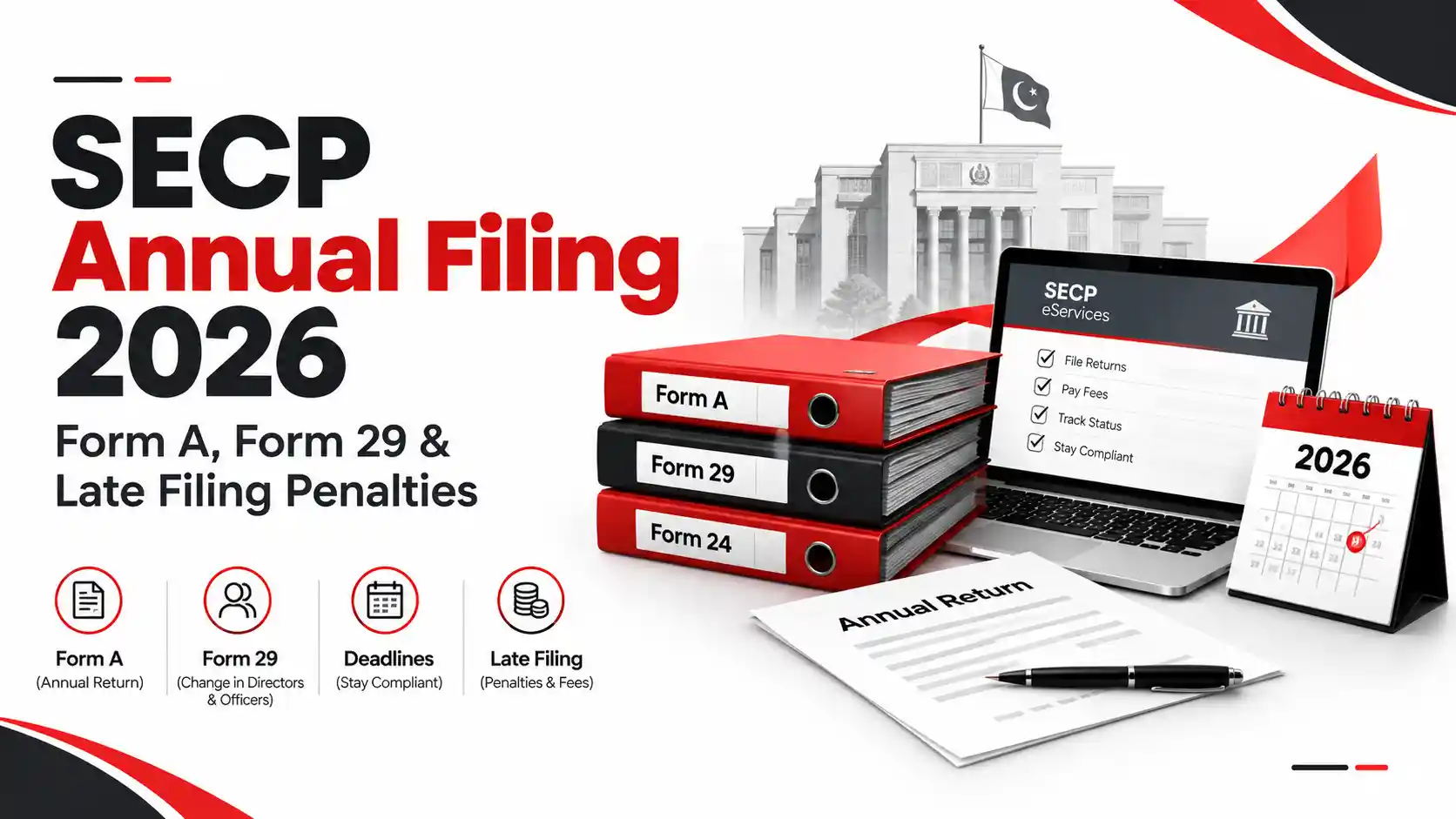
SECP Annual Return Deadline 2026
The annual return deadline is tied to the AGM, so start with the AGM date.
- The first AGM must be held within 16 months of incorporation. Later AGMs must be held within 120 days after the close of the financial year, and a 30-day extension can be obtained.
- SECP's guidance sets the annual return deadline for listed companies at 30 days from the AGM, which the registrar may extend to 45 days, and for other companies at 30 days from the AGM.
- Companies that do not hold an AGM, including SMCs, make up the return as at the last day of the calendar year.
Worked timeline: financial year ending 30 June 2026
| Milestone | Latest date (no extension) |
|---|---|
| Financial year ends | 30 June 2026 |
| AGM (120 days) | 28 October 2026 |
| Form A / Form 24 (30 days after AGM, if the AGM is held on 28 October) | 27 November 2026 |
If the AGM is held earlier, the 30-day clock starts earlier. Count from the actual AGM date, not the latest permitted date.
Separate deadline: financial statements are a different filing. Under section 233, listed companies file accounts within 30 days after the AGM and other companies within 15 days after the AGM. Private companies with capital up to Rs 1 million file unaudited accounts, and those with capital above Rs 1 million up to Rs 10 million do not need to file.
Other Declarations That Travel With the Annual Return
Two further declarations are filed together with the annual return and are easy to overlook:
- Form 19 (ultimate beneficial owners). After updating its register of beneficial owners, a company must file a compliance declaration with the registrar on Form-19 along with its annual return. A UBO is a natural person who ultimately owns or controls the company through at least 25% of shares or voting rights, or through effective control by other means.
- Form 11 (interests in foreign companies). Where substantial shareholders or officers hold interests in foreign companies, the company reports this on Form-11 with its annual return, or within thirty days of the calendar year-end if no annual return is required.
Share Allotments, Transfers and Form 3
Changes in shareholding do not wait for the annual return. Two events have their own deadlines and are reported on Form 3.
1. New shares issued (return of allotment). A company must file a return of allotment with the registrar on Form-3 within 45 days of the allotment date.
2. Major change in ownership. A company must inform the registrar within 15 days, on Form-3 with a supporting affidavit, when more than 25% of its shareholding, membership or voting rights changes.
3. Smaller transfers. Through Circular No. 9 of 2024, dated 22 March 2024, SECP clarified that a company other than a listed company may also file Form-3 for a change of 25% or less, so that shareholding records stay up to date. For smaller transfers, filing is optional but advisable.
| Event | Form | Deadline |
|---|---|---|
| Allotment of new shares | Form 3 (return of allotment) | 45 days from allotment |
| Change of more than 25% in shareholding or voting rights | Form 3 + affidavit | 15 days |
| Change of 25% or less (unlisted companies) | Form 3 (optional) | Recommended soon after the transfer |
| Every transfer during the year | Reflected in Form A | With the annual return |
Transfer rules for private companies
Before shares in a private company are sold to an outsider, section 76 of the Act and regulation 40 require the selling member to offer them to the board first. Only if all members decline can the shares be sold to an outsider, and not below the price offered to members. Skipping this step is one of the most common reasons share transfers are later disputed.
How this connects to Form A
Every allotment and transfer during the year must appear in the next Form A. If Form 3 was filed mid-year, the shareholding in Form A has to match it exactly. A transfer that happened but was never reported also rules out Form 24, because the company's particulars have changed.
Example: A private company with paid-up capital of Rs 5 million has two shareholders. In March 2026, one of them transfers 30% of the company to a new investor. The company must file Form 3 with an affidavit within 15 days. At the end of the year it cannot use Form 24, because the membership has changed, so it must file Form A showing the new investor.
SECP Filing Fee 2026
Filing fees are set out in the Seventh Schedule to the Companies Act 2017. In the version effective from 20 April 2026, the fee for filing, registering or recording documents such as annual returns (other than those listed separately) is Rs 1,331 for electronic submission and Rs 1,997 for physical submission, for companies with share capital. The same Rs 1,331 / Rs 1,997 rates apply to companies limited by guarantee without share capital and to section 42 companies.
| Item | Online (eZfile) | Physical |
|---|---|---|
| Form A / Form 24 / Form 9, per document | Rs 1,331 | Rs 1,997 |
| Certified copy of a return, private company | Rs 100 | Rs 600 |
| Certified copy of a return, other companies | Rs 200 | Rs 900 |
The Schedule states that this fee rises by 10% after each year, with the latest increase taking effect on 20 April 2026. Always check the live fee on eZfile at the time of payment.
Inactive companies pay an annual fee instead, based on authorised capital. For online filing, it is Rs 1,000 for companies without capital or with authorised capital up to Rs 5 million, Rs 2,000 for capital above Rs 5 million up to Rs 10 million, and Rs 5,000 above Rs 10 million.
SECP Late Filing Fees and Penalties
The section 468 additional fee
Section 468 lets the registrar accept a late document on payment of an additional fee. The fee grows with the length of the delay. SECP's own presentation on the Act describes the slabs as follows: an additional fee of one times the normal fee within 3 months, two times within 6 months, three times within 1 year, and four times within 2 years.
| Delay after due date | Additional fee | Total payable (online, illustrative at Rs 1,331) |
|---|---|---|
| Up to 3 months | 1x normal fee | Rs 1,331 + Rs 1,331 = Rs 2,662 |
| Up to 6 months | 2x normal fee | Rs 1,331 + Rs 2,662 = Rs 3,993 |
| Up to 1 year | 3x normal fee | Rs 1,331 + Rs 3,993 = Rs 5,324 |
| Up to 2 years | 4x normal fee | Rs 1,331 + Rs 5,324 = Rs 6,655 |
These totals are our own illustration using the April 2026 online fee. eZfile calculates the actual amount when you file.
The fee applies per document. A company that is late with both Form A and two Form 9s pays the additional fee on all three.
Why the two-year window matters
The same SECP presentation explains that, for delays of up to two years, the late fee is the full and final liability and no adjudication proceedings are started, but that this concession does not extend to public interest companies. In other words, a company other than a public interest company can file within two years of the due date with the section 468 additional fee and face no proceedings for the delay.
Beyond two years, the position is weaker. SECP's FAQs say the registrar may still accept a document presented more than two years after its due date if it is in order, subject to the specified additional fee. However, the company no longer has the protection from proceedings. It can then face penalties under the Act's standard scale, and officers in default can be held personally liable.
Consequences of prolonged non-filing
- Inactive register. If a company fails to file financial statements or annual returns for two consecutive financial years, the registrar will issue a notice and may enter the company in the register of inactive companies.
- Winding-up ground. Default in filing financial statements or annual returns for two financial years is one of the grounds on which a company can be wound up by the court.
- Practical fallout. Banks, tender committees and investors often ask for a recent certified Form A or officer list. A stale record delays these transactions.
How to File Form A, Form 24 or Form 9 Online Through eZfile
SECP's current filing portal is eZfile (reached through SECP's LEAP login). Forms and returns can be filed online through eZfile, or in physical form signed by the authorised officer or intermediary with the necessary documents and proof of fee payment.
- Log in to eZfile with the company's authorised user. If the user was set up years ago, confirm now that the login and 4-digit signing PIN still work.
- Open the company dashboard and choose the right process: annual return (Form A), no-change return (Form 24), or induction, cessation or change of officers (Form 9).
- Check the pre-filled data. eZfile pulls in the last recorded position. Update shareholders, transfers, officers and the registered office to match your statutory registers.
- Attach supporting documents. For Form 9, this means consents, resignation letters, and affidavits where required.
- Add the UBO declaration (Form 19) and Form 11 if applicable.
- Sign digitally using the authorised officer's PIN.
- Pay the fee. Accepted methods include credit or debit card, 1Bill (1Link) through digital banking, mobile banking, Easypaisa, ATM or over the counter, or a bank challan at a designated branch.
- Save the acknowledgement and track the status until the registrar accepts the filing.
Online vs manual filing
| Online (eZfile) | Manual | |
|---|---|---|
| Fee | Lower (Rs 1,331) | Higher (Rs 1,997) |
| Speed | Faster; status is visible on the dashboard | Diary, scanning and physical processing |
| Payment | Card, 1Bill, Easypaisa, etc. | Original paid challan must be attached |
| Best for | Almost every company | Cases where online filing is not yet available |
How to Get a Certified True Copy of Form A or Form 9
Banks, tender committees, landlords and investors often ask for a certified true copy (CTC) of the latest annual return or officers' return. Many people still search for "Form A and Form 29 CTC", but on eZfile you are looking for Form A and Form 9.
Digital CTC
Since 2021, SECP has issued digitally certified true copies of statutory returns and the mortgage register. Once the online application is submitted and payment is verified, the copies are sent by email to the registered address. This replaced the old practice of collecting paper copies in person. The eZfile portal includes a dedicated process for applying for a certified true copy of Form 9.
Steps:
- Log in to eZfile and select the company.
- Choose the certified copy process and select the documents you need (Form A, Form 9, incorporation certificate, etc.).
- Pay the fee online.
- Download the digitally certified copy from the email or your eZfile dashboard.
Certified copy fees (Seventh Schedule, 2026)
| Document | Online | Physical |
|---|---|---|
| Certified copy of any return (excluding financial statements), private company | Rs 100 | Rs 600 |
| Certified copy of any return, other companies | Rs 200 | Rs 900 |
| Certified copy of incorporation or other certificate | Rs 100 | Rs 600 |
| System-generated company profile | Rs 1,000 | — |
| System-generated details of officers | Rs 200 | — |
Before you apply
A CTC shows only what has been filed with SECP. If a director has resigned but Form 9 has not been filed, the CTC will still show that director, and the bank or client will rely on it. File any pending Form 9 or Form A first, and then order the copy.
Documents and Information to Prepare Before Filing
- Certificate of incorporation and CUIN
- Updated register of members and share transfer records
- Register of directors and officers, with CNIC/passport details
- AGM notice and minutes (or calendar year-end date for SMCs)
- Board resolutions for appointments, removals and the auditor
- Resignation letters and consents to act for any officer changes
- Updated register of ultimate beneficial owners
- Details of officers' or substantial shareholders' interests in foreign companies
- Registered office address evidence, if it changed
- eZfile credentials and the authorised officer's signing PIN
Common Mistakes We See
- Searching for "Form 29" on eZfile. The process now sits under Form 9, the directors and officers return.
- Filing Form 24 when something changed. A single share transfer or a change of auditor makes Form A mandatory.
- Skipping Form 24 because "nothing changed". Only SMCs and private companies with paid-up capital up to Rs 3 million can skip the return entirely.
- Missing the 15-day Form 9 window. Board changes are often recorded in minutes but never filed.
- Forgetting Form 19. The UBO compliance declaration is filed alongside the annual return and is frequently left out.
- Leaving a departed director on the record. This keeps the former director exposed and puts the company in breach.
- Treating SECP and FBR filings as the same thing. A company's income tax return is a separate obligation. See our guide to Pakistan corporate tax rates, filing and compliance and the FBR late filing penalty calculator for the tax side.
- Letting delays run past two years. The additional fee is manageable. What becomes costly is losing the two-year protection.
- Ordering a CTC before updating the record. A certified copy only shows what has been filed, so an unfiled resignation will still appear on it.
Expert Tips: How to Stay SECP Compliant All Year
- Build a compliance calendar anchored to your financial year-end: AGM, then accounts, then annual return. Our corporate compliance calculator is a useful starting point.
- File Form 9 in the same week as the board resolution. Do not wait for the annual return.
- Reconcile before you file. Compare your statutory registers with the eZfile record so that Form A does not contradict earlier Form 9 filings.
- Plan for the April fee increase. Fees rise each April, so filing earlier in the year saves a little.
- Catch up in the right order. If several years are outstanding, file the oldest returns first so that each return builds correctly on the last.
- Match SECP and FBR data. Directors, shareholders and addresses should be the same across both regulators. Our business tax compliance guide and company NTN registration service cover the FBR side.
Because eZfile is fully online, filings can be managed remotely for companies registered at any of SECP's nine Company Registration Offices. These are Faisalabad, Gilgit, Islamabad, Karachi, Lahore, Multan, Peshawar, Quetta and Sukkur. This makes it practical to support businesses in Rawalpindi, Sialkot and other cities that fall under these offices.
Why Choose Baco Consultants for SECP Annual Filing
Baco Consultants combines chartered accountancy and legal expertise under one roof. The firm is led by Rai Basharat Ali, a chartered accountant (ACA, ICAEW) and Advocate High Court. This matters for SECP compliance, where a filing can raise both a company-law question (who is a UBO, is the auditor validly appointed) and a tax question (does the FBR record match).
What we handle:
- Form A, Form 24 and Form 9 preparation and eZfile submission
- UBO register updates and Form 19 declarations
- Catch-up filing plans for overdue returns, with the additional fee worked out in advance
- AGM documentation, board resolutions and statutory registers
- Coordinating your SECP record with FBR registration and tax filings
If you are still choosing a structure, see the difference between a sole proprietor and a company in Pakistan, our single member company registration service, or our SECP registration consultant in Islamabad page. You can learn more about us.
Frequently Asked Questions
What is the SECP annual return?
It is a yearly snapshot of a company's officers, members, capital and registered office, filed with the registrar under section 130 of the Companies Act 2017, usually on Form A.
What is Form A in SECP?
Form A is the annual return. Since the Companies Regulations 2024, it is used by companies both with and without share capital, including inactive companies.
What is Form 29 in SECP?
Form 29 was the return for appointments, cessations and changes of directors and officers. Under the Companies Regulations 2024, it has been replaced by Form 9.
When is Form 29 (Form 9) due?
Within 15 days of the appointment, cessation or change in particulars.
Is Form 29 required every year?
No. It is filed only when a director or officer changes.
What is Form 24 in SECP?
Form 24 (formerly Form C) is the annual return used when nothing has changed since the last return. Public companies and private companies with paid-up capital above Rs 3 million must file it.
Does my SMC need to file Form A?
Only if something has changed since the last annual return. If nothing has changed, an SMC does not need to file an annual return. Changes to the nominee or officers still go on Form 9.
When is the SECP annual return due in 2026?
Generally within 30 days of the AGM. For a 30 June 2026 year-end with the AGM held on the last permitted day (28 October 2026), Form A or Form 24 is due by 27 November 2026.
How much is the SECP annual filing fee in 2026?
From 20 April 2026, Rs 1,331 per document online and Rs 1,997 physically, for most company types.
What is the SECP late filing fee?
An additional fee of 1x the normal fee for delays up to 3 months, 2x up to 6 months, 3x up to 1 year, and 4x up to 2 years.
What happens if I file more than two years late?
The registrar may still accept the filing with the additional fee. However, the protection from proceedings is lost, and the company and its officers can face penalties.
Can I file Form A and Form 9 online?
Yes. Both are filed through SECP's eZfile portal, and online filing costs less than physical filing.
What does a dormant company need to file?
A company granted inactive status under section 424 files Form A with the inactive company annual fee within 30 days of each calendar year-end.
How can I check my company's SECP compliance status?
Log in to eZfile to review past filings and the current record. You can also obtain a certified copy of the latest return or the officers list from SECP.
How do I get a certified copy of Form A or Form 29 (Form 9)?
Apply through eZfile, select the documents and pay online. SECP emails a digitally certified copy once the payment is verified.
How much does an SECP certified true copy cost?
For a private company, a certified copy of a return costs Rs 100 online or Rs 600 physically. For other companies, it costs Rs 200 online or Rs 900 physically.
Do I need to report a share transfer to SECP?
Yes, on Form 3 within 15 days where more than 25% of shareholding or voting rights changes. Smaller changes can also be reported on Form 3, and every transfer must appear in the next Form A.
Can I file Form 24 if shares were transferred during the year?
No. A share transfer changes the company's particulars, so Form A is required.
Conclusion
SECP annual filing in 2026 comes down to three questions. Did anything change this year (Form A or Form 24)? Did any director or officer change (Form 9 within 15 days)? Are you inside the deadline (if not, how many multiples of the fee apply)? The rules are manageable once you know the current form numbers. The costly errors come from outdated habits, such as searching for Form 29 or assuming "no change" means "no filing".
If your company has an AGM coming up, a board change to report, or returns from past years still outstanding, now is the time to fix it, before the delay moves into the next slab. Book a Seat at Baco Consultants and our corporate compliance team will review your SECP record, prepare the correct forms and file them on eZfile.
Related Articles


Leave a Comment
No approved comments yet. Be the first to share your thoughts!