

Introduction
Starting a business on your own in Pakistan? Registering as a sole proprietor is the simplest, fastest, and most affordable way to get your business off the ground legally. Whether you're a freelancer, a shopkeeper, a consultant, or a small business owner, sole proprietorship registration gives you a legal identity, opens the door to a business bank account, and puts you on the right side of FBR compliance.
In 2026, the process has become more streamlined thanks to Pakistan's digital infrastructure — and with the right guidance, you can complete your registration without unnecessary delays or confusion. This guide walks you through everything you need to know, from documents to fees to common mistakes.
What Is a Sole Proprietorship in Pakistan?
A sole proprietorship is the simplest form of business structure in Pakistan. It is owned and operated by a single individual — you are the business. There's no separate legal entity, no board of directors, and no complex partnership agreements. You make decisions, bear responsibilities, and enjoy the profits.
Unlike a private limited company registered with SECP, a sole proprietorship doesn't require formal company incorporation. Instead, registration primarily happens through the Federal Board of Revenue (FBR) by obtaining a National Tax Number (NTN) and, if applicable, a Sales Tax Registration Number (STRN).
This is exactly why sole proprietorship is the most common business structure in Pakistan — it's practical, low-cost, and easy to manage.
Why Sole Proprietorship Registration Matters in Pakistan
Many small business owners in Pakistan operate without formal registration, and that's a significant risk. Here's why getting registered in 2026 matters more than ever:
Legal Recognition: A registered sole proprietorship gives your business a recognized legal status, which is essential for signing contracts, issuing invoices, and dealing with vendors and clients professionally.
Banking Access: Without an NTN and business registration proof, you cannot open a dedicated business bank account in Pakistan — which limits how you receive payments, especially from international clients.
Tax Compliance: FBR has intensified its crackdown on unregistered businesses. Being on the Active Taxpayer List (ATL) protects you from additional tax withholdings and penalties.
Freelancers and IT Professionals: If you're a freelancer earning in foreign currency, a registered sole proprietorship makes you eligible for official export income tax benefits under the IT sector exemptions.
Client and Vendor Trust: Businesses and corporations prefer to work with registered entities. Having your NTN and STRN adds credibility and professionalism to your operations.
Key Benefits of Registering a Sole Proprietorship in Pakistan
- Low cost — No heavy registration fees compared to company formation
- Simple process — Primarily done through FBR's IRIS portal
- Full control — You make every decision independently
- Tax advantages — Access to income tax slabs favorable for small businesses
- Quick setup — Registration can be completed within days when done correctly
- GST/Sales Tax compliance — STRN registration allows you to charge and claim sales tax
- Business bank account eligibility — Required by most banks in Pakistan
- Export income benefits — Especially relevant for freelancers and IT service providers
Documents Required for Sole Proprietorship Registration in Pakistan
Before you begin, make sure you have the following documents ready:
- Original CNIC / NICOP (for overseas Pakistanis)
- Active mobile number linked to your CNIC (for OTP verification)
- Personal email address
- Business name (your trade name or brand name)
- Business address (can be your home address for small businesses)
- Nature of business (services, trading, manufacturing, etc.)
- Utility bill of business premises (electricity, gas, or phone — not older than 3 months)
- Bank account details (if already available)
If you're registering for STRN (Sales Tax Registration), you may also need:
- Rent agreement or ownership documents for business premises
- Bank account maintenance certificate
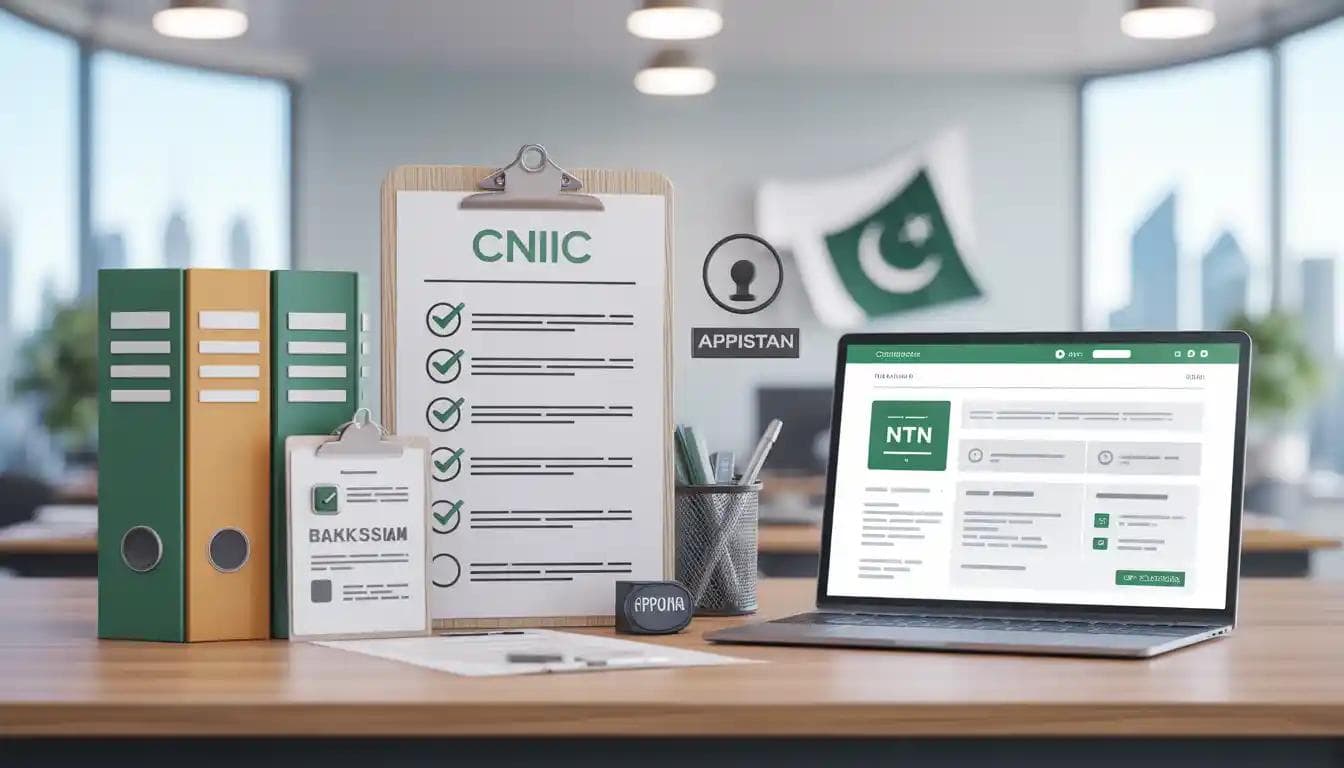
Step-by-Step Process to Register a Sole Proprietorship in Pakistan 2026
Step 1: Visit the FBR IRIS Portal
Go to iris.fbr.gov.pk — this is the official FBR IRIS portal where all NTN and tax registrations are handled online. This is where your journey begins.
Step 2: Create a New Registration Account
Click on "Registration for Unregistered Person" on the IRIS portal homepage. You'll be asked to enter your CNIC number and mobile number. An OTP will be sent to verify your identity. Once verified, you'll receive login credentials via SMS and email.
Step 3: Log In and Complete Your Profile
Use the credentials sent to your email and phone to log into the IRIS portal. Once inside, navigate to Draft > Registration and open the registration form.
Step 4: Fill in Business Information
Enter your business details carefully:
- Business name (this will appear on your NTN certificate)
- Business type — Select "Sole Proprietor / Individual"
- Business address and contact details
- Nature of business / business activity codes — Choose the most relevant category from FBR's list
- Commencement date of business
Step 5: Upload Required Documents
Attach scanned copies of your CNIC (front and back), utility bill, and any other required documents. Make sure scans are clear and legible — blurry uploads are a common cause of rejection.
Step 6: Submit the Registration Application
Review all the information carefully. Once satisfied, submit the form. FBR will process your application and, if everything is in order, issue your NTN (National Tax Number) — sometimes within 24 to 72 hours.
Step 7: Apply for STRN (If Required)
If your annual turnover exceeds the sales tax threshold, or if you want to register for GST voluntarily (recommended for B2B businesses), apply for STRN registration through the same IRIS portal. Go to Registration > Sales Tax and complete the additional form.
Step 8: Obtain Business Bank Account
Once you have your NTN certificate, visit your preferred bank with your CNIC, NTN certificate, and business registration proof to open a current account in your business name.
Step 9: File Tax Returns Annually
As a sole proprietor, you're required to file annual income tax returns. Pakistan's income tax slab for individuals and sole proprietors applies based on your net income. Staying compliant keeps you on the Active Taxpayer List and avoids penalties.
Sole Proprietorship Registration Fees in Pakistan 2026
One of the biggest advantages of sole proprietorship over a private limited company is the cost. Here's a general breakdown:
- NTN Registration: Free of charge (no government fee)
- STRN Registration: Free of charge through IRIS portal
- Professional Service Fee: If you hire a consultant or firm to assist you, fees typically range from PKR 5,000 to PKR 20,000 depending on the service provider
- Business bank account: No registration fee, though a minimum deposit may be required by the bank
Common Mistakes to Avoid During Sole Proprietorship Registration
Even a simple process like this can go wrong. Here are the most frequent mistakes people make:
1. Using an Incorrect Business Category Code FBR's system uses specific activity codes. Selecting the wrong one can create issues with your tax profile. Take time to review the correct code for your business type.
2. Mismatched Information Your CNIC details, mobile number, and address must match exactly what NADRA has on record. Any discrepancy will cause your application to be rejected or delayed.
3. Uploading Low-Quality Documents Blurry or incomplete document scans are a leading cause of application rejection. Always upload clear, high-resolution scans.
4. Skipping STRN When Required Many business owners skip sales tax registration thinking it's optional. If you supply goods or services subject to sales tax, STRN is mandatory — and operating without it can result in heavy penalties.
5. Not Filing Annual Returns Getting an NTN is just the beginning. Many people register and then never file their tax returns, which removes them from the Active Taxpayer List and results in higher withholding taxes on transactions.
6. Ignoring Provincial Tax Registration Depending on your province and business type, you may also need to register for Punjab Revenue Authority (PRA) or Sindh Revenue Board (SRB) for services. This is often overlooked.
Why Choose Baco Consultants for Sole Proprietorship Registration?
Navigating FBR's IRIS portal and understanding Pakistan's tax registration requirements can feel overwhelming — especially if it's your first time. That's where Baco Consultants steps in.
Baco Consultants is a trusted name in business registration, taxation, and compliance services in Pakistan. Whether you need help with NTN registration, STRN filing, or annual tax returns, the expert team at Baco Consultants has the knowledge and hands-on experience to get things done right — the first time.
Here's why businesses and individuals across Pakistan rely on Baco Consultants:
- Experienced Professionals: The team includes tax consultants and compliance experts with deep knowledge of FBR and SECP regulations
- Fast Processing: Your registration is handled with priority to minimize turnaround time
- End-to-End Support: From document preparation to submission and follow-up, everything is managed for you
- Affordable Packages: Professional service doesn't have to break the bank — Baco Consultants offers competitive pricing for individuals and small businesses
- FBR & Compliance Expertise: With direct experience in FBR filings, tax returns, and business structuring, you're in safe hands
Explore the full range of services offered by Baco Consultants including business registration, income tax filing, sales tax compliance, and business advisory. You can also read more about the firm's background and values on the About page.
For the latest updates and guides on Pakistani tax and business law, the Baco Consultants blog is a valuable free resource worth bookmarking.

Real-World Example: How Registration Helped a Lahore-Based Freelancer
Consider Ahmed, a graphic designer based in Lahore who had been freelancing on international platforms for two years. He was earning well in USD but had no formal business registration. When a corporate client in Karachi asked for an invoice with NTN, he couldn't provide one. He was also losing money on unnecessary withholding taxes at his bank.
Ahmed reached out to Baco Consultants, who guided him through the sole proprietorship registration process. Within three working days, Ahmed had his NTN certificate, a business name on record, and was officially registered as a sole proprietor. He then opened a business current account, started invoicing professionally, and even qualified for the IT export income tax exemption.
The result? More credibility, cleaner finances, and significant tax savings — all from a process that cost him less than a dinner out.
Frequently Asked Questions (FAQs)
Q1: How to register a sole proprietorship in Pakistan? Register through FBR's IRIS portal at iris.fbr.gov.pk using your CNIC and mobile number. Complete the individual registration form, upload documents, and receive your NTN. The process is entirely online and free of government fees.
Q2: What documents are required for sole proprietorship registration in Pakistan? You need your CNIC (front and back), a mobile number linked to CNIC, a personal email address, your business name and address, and a utility bill of the business premises not older than three months.
Q3: How long does sole proprietorship registration take in Pakistan? Once the application is submitted correctly with all required documents, NTN issuance typically takes 24 to 72 working hours through the FBR IRIS portal.
Q4: Can I register a sole proprietorship online in Pakistan? Yes. The entire registration process for an NTN is done online through FBR's IRIS portal. No physical visit to an FBR office is required for standard registration.
Q5: Do I need an NTN for a sole proprietorship in Pakistan? Yes. NTN is the foundational requirement for operating as a registered sole proprietor. It is required for opening a business bank account, issuing formal invoices, and maintaining tax compliance.
Q6: What is the tax rate for sole proprietorship in Pakistan in 2026? Sole proprietors are taxed as individuals under Pakistan's income tax slabs. Rates range from 0% for income up to PKR 600,000 annually, increasing progressively for higher income brackets. IT exporters may qualify for reduced rates or exemptions.
Conclusion and Call to Action
Registering a sole proprietorship in Pakistan in 2026 is genuinely one of the most accessible things a small business owner, freelancer, or independent professional can do to protect and legitimize their business. The process is online, the government fees are zero, and the benefits — legal recognition, banking access, tax compliance, and client trust — are immediate and substantial.
The key is doing it correctly from day one: right documents, right business codes, right filings. One small error can cause delays that cost you clients and opportunities.
If you'd prefer to skip the guesswork and have experts handle every step for you, Baco Consultants is your trusted partner for business registration, FBR filings, and ongoing tax compliance in Pakistan.
Ready to register your sole proprietorship the right way? Contact Baco Consultants today and let their professional team get your business officially on the map — fast, accurately, and affordably.
Related Articles


Leave a Comment
No approved comments yet. Be the first to share your thoughts!