
Introduction
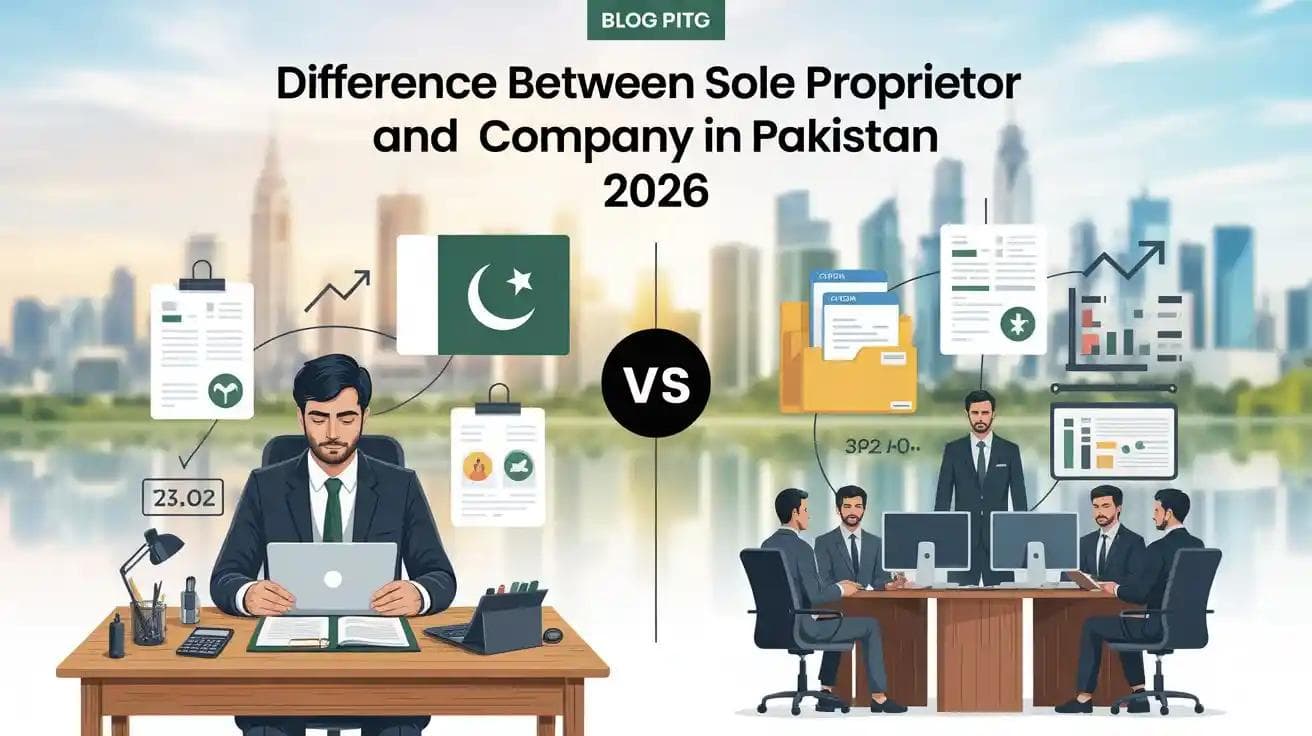
One of the most important decisions any entrepreneur makes when starting a business in Pakistan is choosing the right legal structure. Should you register as a sole proprietor and keep things simple? Or should you go through SECP and set up a private limited company for greater credibility and protection?
The difference between a sole proprietor and a company in Pakistan isn't just about paperwork — it affects your taxes, your liability, your ability to raise investment, and how clients and banks perceive you.
In 2026, with Pakistan's regulatory environment evolving and FBR tightening compliance requirements, making the right choice from the start matters more than ever. This guide breaks down everything you need to know clearly, practically, and without the legal jargon.
What Is a Sole Proprietorship in Pakistan?
A sole proprietorship is the simplest business structure available in Pakistan. It is owned and operated by a single individual — there is no legal separation between you and your business. You are the business.
Registration is done through the Federal Board of Revenue (FBR) by obtaining a National Tax Number (NTN). There is no requirement to register with SECP. You trade under your own name or a business trade name, and all profits — and all liabilities — belong to you personally.
Sole proprietorships are the most popular business form in Pakistan, largely because they are easy to set up, inexpensive to maintain, and require minimal compliance compared to companies.
 is one of Pakistan's trusted business consultancy firms, with hands-on experience in both FBR registrations and SECP company incorporation. Their team doesn't just process paperwork — they help you make the right structural decision for your specific business goals, tax situation, and growth plans. Here's what you get when you work with [Baco Consultants](https://bacoconsultants.com/about/): - **Strategic advice** on which business structure suits your situation and growth plans - **Complete registration handling** — from document preparation to submission and follow-up - **FBR NTN registration** for both individuals and companies - **SECP incorporation services** for private limited and single member companies - **Ongoing compliance management** — annual returns, SECP filings, and tax submissions - **Affordable, transparent pricing** with no hidden charges - **Fast processing** — experienced consultants know exactly how to avoid delays The [professional team at Baco Consultants](https://bacoconsultants.com/team) includes tax consultants, SECP specialists, and business advisors who collectively handle dozens of registrations every month. Explore their full [services portfolio](https://bacoconsultants.com/services/) to see everything from NTN registration to corporate tax planning. For free insights on Pakistan's business registration landscape, the [Baco Consultants blog](https://bacoconsultants.com/blogs) is a consistently updated resource worth bookmarking. --- ## Real-World Example: Why One Islamabad Entrepreneur Switched from Sole Proprietor to Pvt Ltd Bilal ran a software consultancy from Islamabad as a sole proprietor for three years. Business was good — he had regular local clients and his NTN filings were in order. But when he applied for a contract with a large telecom company, he was told they only work with registered companies for invoicing and compliance purposes. Bilal contacted Baco Consultants to discuss his options. The team assessed his income, client profile, and growth plans, then recommended converting to a private limited company. They handled the entire SECP incorporation process, including name reservation, document preparation, and FBR company NTN registration. Within two weeks, Bilal had a Certificate of Incorporation, a corporate bank account, and a company capable of signing the telecom contract. His business has since grown to a team of seven, and the company structure now allows him to bring in a silent investor to fund expansion. The structural change didn't just win him one contract — it transformed the trajectory of his entire business. --- ## Frequently Asked Questions (FAQs) **Q1: What is the main difference between a sole proprietor and a company in Pakistan?** A sole proprietor has no separate legal identity from the owner, with unlimited personal liability and registration only through FBR. A private limited company is a separate legal entity registered with SECP, offering limited liability, corporate tax treatment, and the ability to issue shares and attract investors. **Q2: Which is better — sole proprietorship or company in Pakistan?** It depends on your business size, goals, and risk profile. Sole proprietorship is ideal for small, low-risk, single-owner businesses. A company is better for businesses targeting growth, corporate clients, investment, or those in higher-risk industries. **Q3: What are the tax differences between sole proprietor and company in Pakistan?** Sole proprietors are taxed as individuals under Pakistan's income tax slabs (0% to 35% depending on income). Private limited companies pay corporate tax at 29%. At lower income levels, individual slabs can be more favorable; at higher levels, corporate rates may offer advantages. **Q4: Can a sole proprietor convert to a company in Pakistan?** Yes. A sole proprietor can incorporate a private limited company through SECP at any time. The business assets, contracts, and operations can be transferred to the new company, though this process requires proper legal and tax planning. **Q5: Is a company more expensive to maintain than a sole proprietorship in Pakistan?** Yes. A private limited company has higher ongoing costs — SECP annual filing fees, mandatory audited accounts, compliance management, and potentially a company secretary. A sole proprietorship only requires annual income tax return filing. **Q6: Do I need a lawyer to register a company in Pakistan?** You don't legally need a lawyer, but working with an experienced business consultant or firm like Baco Consultants significantly reduces the risk of errors, rejected applications, and compliance gaps — especially for first-time company owners. --- ## Conclusion and Call to Action The difference between a sole proprietor and a company in Pakistan comes down to four core factors: **liability, taxation, compliance, and growth potential**. Neither structure is universally better — the right choice is the one that aligns with your current situation and where you want your business to go. Sole proprietorship offers simplicity and low cost — perfect for starting out. A private limited company offers protection, credibility, and scalability — essential when you're ready to grow. The most important thing is making this decision with accurate information and expert guidance, not guesswork. If you're ready to register your business the right way — whether as a sole proprietor or a private limited company — [Baco Consultants](https://bacoconsultants.com/) is here to guide you every step of the way. From structure selection to SECP incorporation, FBR registration, and ongoing compliance, their team handles it all. **Book your consultation today.** [Contact Baco Consultants](https://bacoconsultants.com/contact) and take the first step toward building your business on a solid, legally sound foundation in Pakistan.](/_next/image?url=https%3A%2F%2Fcdn.sanity.io%2Fimages%2Fmd13keq1%2Fproduction%2Feb869e9be9d408566a2367f2858682e6ae094be7-1312x736.webp&w=3840&q=75)
What Is a Private Limited Company in Pakistan?
A private limited company (Pvt Ltd) is a separate legal entity registered with the Securities and Exchange Commission of Pakistan (SECP). It has its own legal identity, distinct from its owners (shareholders and directors).
A Pvt Ltd company can own assets, enter contracts, sue and be sued, and continue to exist even if ownership changes. It requires a minimum of two directors, a registered office address, Memorandum and Articles of Association (MoA & AoA), and ongoing annual compliance with SECP and FBR.
A Single Member Company (SMC) is a variation that allows one individual to form a private limited company — a useful middle ground for solo entrepreneurs who want corporate protection.
Why This Comparison Matters for Pakistani Entrepreneurs in 2026
Choosing between a sole proprietorship and a private limited company is not a one-size-fits-all decision. The right answer depends on your business goals, your risk tolerance, your target clients, and your long-term growth plans.
Here's why this decision carries real weight in Pakistan's current business environment:
Tax implications are significant. Sole proprietors are taxed as individuals under Pakistan's income tax slabs. Companies are taxed at the corporate tax rate, which in many cases can be more favorable for higher-income businesses — but comes with stricter compliance obligations.
Client and investor perception matters. Many corporate clients, government departments, and international buyers prefer — or outright require — dealing with a registered company. A Pvt Ltd structure signals professionalism, permanence, and accountability.
Liability protection is real. A sole proprietor has unlimited personal liability. If your business faces a lawsuit or debt, your personal savings, property, and assets are at risk. A company limits that liability to the company's assets in most cases.
Growth and investment access differ. A company can issue shares, attract investors, and scale in ways a sole proprietorship simply cannot.
Side-by-Side Comparison: Sole Proprietor vs Company in Pakistan
Legal Identity
- Sole Proprietor: No separate legal entity — the owner IS the business
- Private Limited Company: Separate legal entity — business exists independently of its owners
Registration Authority
- Sole Proprietor: FBR (NTN registration via IRIS portal)
- Private Limited Company: SECP (company incorporation) + FBR (NTN registration)
Liability
- Sole Proprietor: Unlimited personal liability — personal assets at risk
- Private Limited Company: Limited liability — shareholders' risk limited to their investment
Ownership
- Sole Proprietor: Single owner only
- Private Limited Company: 2 to 50 shareholders (or 1 for SMC)
Taxation
- Sole Proprietor: Taxed as individual — income tax slabs apply
- Private Limited Company: Corporate tax rate applies (currently 29% for most companies)
Cost to Register
- Sole Proprietor: Free (FBR NTN registration has no government fee)
- Private Limited Company: SECP registration fees apply based on authorized capital, typically starting from PKR 1,500 to PKR 30,000+
Ongoing Compliance
- Sole Proprietor: Annual income tax return filing
- Private Limited Company: Annual SECP filings, annual tax returns, audited accounts, AGM requirements
Bank Account
- Sole Proprietor: Can open individual or sole proprietor current account
- Private Limited Company: Opens a corporate account in the company's name
Investment and Fundraising
- Sole Proprietor: Cannot issue shares; limited to personal investment or loans
- Private Limited Company: Can issue shares, attract equity investors, and raise capital
Business Continuity
- Sole Proprietor: Ceases to exist if the owner dies or retires
- Private Limited Company: Perpetual succession — continues regardless of ownership changes
Key Benefits of Each Structure
Benefits of Sole Proprietorship in Pakistan
- Fastest and cheapest to set up
- Minimal ongoing compliance costs
- Full decision-making control
- Simple tax filing (individual income tax returns)
- Ideal for freelancers, consultants, small retailers, and local service providers
- No mandatory audit requirement
Benefits of a Private Limited Company in Pakistan
- Limited liability protection for personal assets
- Greater credibility with banks, clients, and investors
- Ability to raise investment through share issuance
- Corporate tax rate can be advantageous at higher income levels
- Separate legal identity enables contracts, property ownership, and legal standing
- Better suited for scaling, hiring, and expanding operations
- Required for government tenders and many B2B corporate contracts
 is one of Pakistan's trusted business consultancy firms, with hands-on experience in both FBR registrations and SECP company incorporation. Their team doesn't just process paperwork — they help you make the right structural decision for your specific business goals, tax situation, and growth plans. Here's what you get when you work with [Baco Consultants](https://bacoconsultants.com/about/): - **Strategic advice** on which business structure suits your situation and growth plans - **Complete registration handling** — from document preparation to submission and follow-up - **FBR NTN registration** for both individuals and companies - **SECP incorporation services** for private limited and single member companies - **Ongoing compliance management** — annual returns, SECP filings, and tax submissions - **Affordable, transparent pricing** with no hidden charges - **Fast processing** — experienced consultants know exactly how to avoid delays The [professional team at Baco Consultants](https://bacoconsultants.com/team) includes tax consultants, SECP specialists, and business advisors who collectively handle dozens of registrations every month. Explore their full [services portfolio](https://bacoconsultants.com/services/) to see everything from NTN registration to corporate tax planning. For free insights on Pakistan's business registration landscape, the [Baco Consultants blog](https://bacoconsultants.com/blogs) is a consistently updated resource worth bookmarking. --- ## Real-World Example: Why One Islamabad Entrepreneur Switched from Sole Proprietor to Pvt Ltd Bilal ran a software consultancy from Islamabad as a sole proprietor for three years. Business was good — he had regular local clients and his NTN filings were in order. But when he applied for a contract with a large telecom company, he was told they only work with registered companies for invoicing and compliance purposes. Bilal contacted Baco Consultants to discuss his options. The team assessed his income, client profile, and growth plans, then recommended converting to a private limited company. They handled the entire SECP incorporation process, including name reservation, document preparation, and FBR company NTN registration. Within two weeks, Bilal had a Certificate of Incorporation, a corporate bank account, and a company capable of signing the telecom contract. His business has since grown to a team of seven, and the company structure now allows him to bring in a silent investor to fund expansion. The structural change didn't just win him one contract — it transformed the trajectory of his entire business. --- ## Frequently Asked Questions (FAQs) **Q1: What is the main difference between a sole proprietor and a company in Pakistan?** A sole proprietor has no separate legal identity from the owner, with unlimited personal liability and registration only through FBR. A private limited company is a separate legal entity registered with SECP, offering limited liability, corporate tax treatment, and the ability to issue shares and attract investors. **Q2: Which is better — sole proprietorship or company in Pakistan?** It depends on your business size, goals, and risk profile. Sole proprietorship is ideal for small, low-risk, single-owner businesses. A company is better for businesses targeting growth, corporate clients, investment, or those in higher-risk industries. **Q3: What are the tax differences between sole proprietor and company in Pakistan?** Sole proprietors are taxed as individuals under Pakistan's income tax slabs (0% to 35% depending on income). Private limited companies pay corporate tax at 29%. At lower income levels, individual slabs can be more favorable; at higher levels, corporate rates may offer advantages. **Q4: Can a sole proprietor convert to a company in Pakistan?** Yes. A sole proprietor can incorporate a private limited company through SECP at any time. The business assets, contracts, and operations can be transferred to the new company, though this process requires proper legal and tax planning. **Q5: Is a company more expensive to maintain than a sole proprietorship in Pakistan?** Yes. A private limited company has higher ongoing costs — SECP annual filing fees, mandatory audited accounts, compliance management, and potentially a company secretary. A sole proprietorship only requires annual income tax return filing. **Q6: Do I need a lawyer to register a company in Pakistan?** You don't legally need a lawyer, but working with an experienced business consultant or firm like Baco Consultants significantly reduces the risk of errors, rejected applications, and compliance gaps — especially for first-time company owners. --- ## Conclusion and Call to Action The difference between a sole proprietor and a company in Pakistan comes down to four core factors: **liability, taxation, compliance, and growth potential**. Neither structure is universally better — the right choice is the one that aligns with your current situation and where you want your business to go. Sole proprietorship offers simplicity and low cost — perfect for starting out. A private limited company offers protection, credibility, and scalability — essential when you're ready to grow. The most important thing is making this decision with accurate information and expert guidance, not guesswork. If you're ready to register your business the right way — whether as a sole proprietor or a private limited company — [Baco Consultants](https://bacoconsultants.com/) is here to guide you every step of the way. From structure selection to SECP incorporation, FBR registration, and ongoing compliance, their team handles it all. **Book your consultation today.** [Contact Baco Consultants](https://bacoconsultants.com/contact) and take the first step toward building your business on a solid, legally sound foundation in Pakistan.](/_next/image?url=https%3A%2F%2Fcdn.sanity.io%2Fimages%2Fmd13keq1%2Fproduction%2F531ff18eff599f0a7e5b89719bcf6199b76f04de-1312x736.webp&w=3840&q=75)
How to Decide: Which Business Structure Is Right for You?
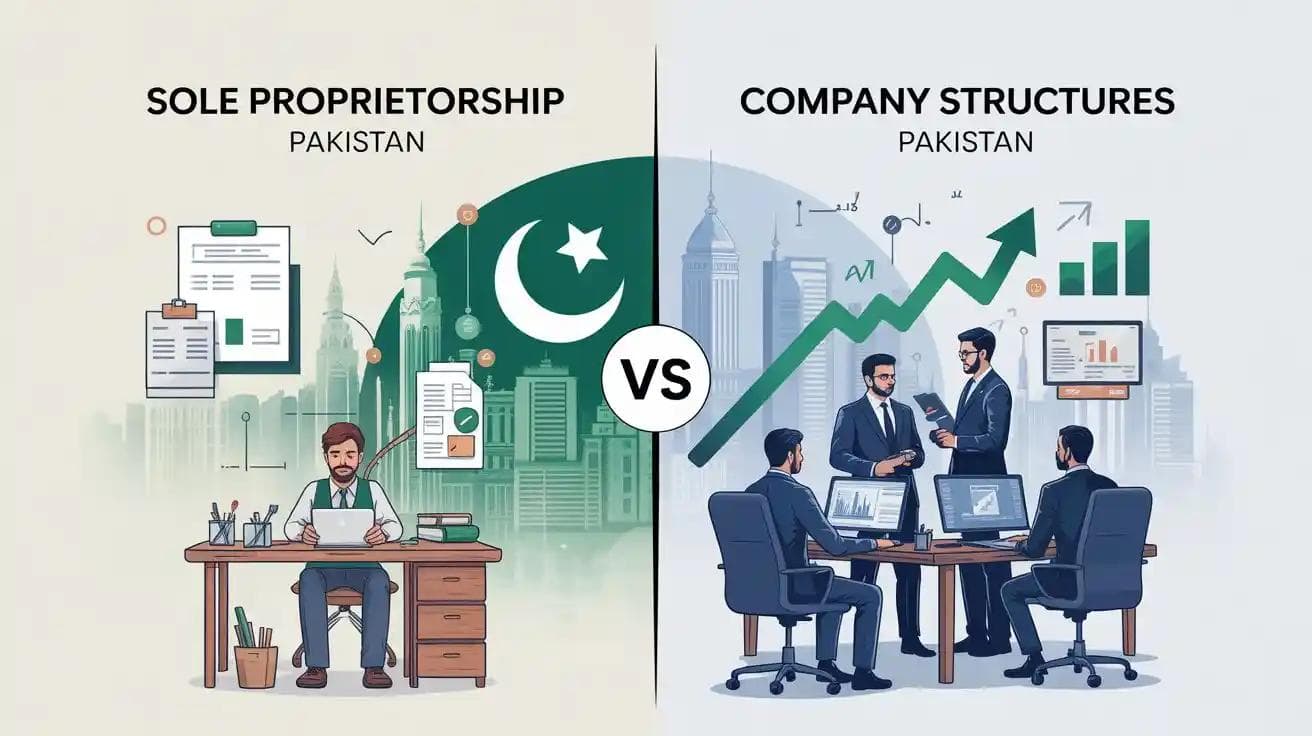
This is the question most people really want answered. Here's a practical framework:
Choose Sole Proprietorship if:
- You're starting small with low overhead
- You're a freelancer, consultant, or independent professional
- Your clients are individuals or small businesses that don't require corporate invoicing
- You want minimal compliance burden
- Your personal liability risk is low
Choose a Private Limited Company if:
- You plan to grow, hire staff, and scale operations
- You're targeting corporate clients, government contracts, or international partnerships
- You want to protect personal assets from business liabilities
- You intend to bring in co-founders, partners, or investors
- You're building a brand with long-term value
Consider a Single Member Company (SMC) if:
- You want the legal protection of a company but prefer to be the sole owner
- You want to separate your personal and business finances completely
- You're a solo consultant or service provider targeting corporate clients
Step-by-Step: How to Register Each Business Structure
Registering a Sole Proprietorship (FBR)
- Visit FBR IRIS portal at iris.fbr.gov.pk
- Click "Registration for Unregistered Person" and verify via CNIC-linked OTP
- Log in with credentials sent via SMS/email
- Fill in your personal and business details, select "Sole Proprietor/Individual"
- Upload CNIC and utility bill of business premises
- Submit and receive NTN certificate within 24–72 hours
Registering a Private Limited Company (SECP + FBR)
- Check name availability on SECP's online portal (eservices.secp.gov.pk)
- Reserve company name through SECP's online system
- Prepare incorporation documents — MoA, AoA, Form 1 (declaration of compliance), Form 21 (registered office address), Form 29 (particulars of directors)
- Pay SECP registration fee based on authorized capital
- Submit documents online via SECP's eServices portal
- Receive Certificate of Incorporation — typically within 2 to 5 working days for online applications
- Register with FBR — apply for company NTN through IRIS portal using SECP incorporation documents
- Open corporate bank account with Certificate of Incorporation, NTN, and MoA/AoA
Common Mistakes to Avoid When Choosing a Business Structure
1. Choosing Sole Proprietorship for High-Risk Businesses If your business involves significant financial exposure, contracts with large corporations, or imported goods, operating as a sole proprietor exposes all your personal assets. A company's limited liability protection exists for exactly these situations.
2. Registering a Company When It's Not Necessary Some first-time entrepreneurs register a Pvt Ltd company thinking it sounds more professional, then struggle with annual compliance costs, SECP filing deadlines, and mandatory audits. If you're just starting out solo, a sole proprietorship may serve you better for the first year or two.
3. Not Considering Tax Implications At lower income levels, individual tax slabs can actually be more favorable than corporate tax rates. At higher income levels, the reverse may be true. Many business owners choose their structure without consulting a tax professional — and end up paying more than they should.
4. Ignoring Ongoing Compliance Requirements A company isn't just a registration certificate. It comes with annual SECP filings, AGM requirements, and mandatory audited accounts. Many entrepreneurs register companies and then fall behind on compliance, attracting penalties.
5. Not Separating Personal and Business Finances This mistake is common among sole proprietors. Even without a formal company, keeping separate bank accounts for business transactions is essential for clean bookkeeping and accurate tax filings.
6. Delaying Registration Entirely Some business owners operate informally for years, avoiding both sole proprietorship and company registration. In 2026, FBR's expanded enforcement means this approach increasingly leads to penalties, higher withholding taxes, and being locked out of formal business opportunities.
Why Choose Baco Consultants for Business Registration in Pakistan?
Whether you decide to register as a sole proprietor or incorporate a private limited company, having expert guidance saves you time, money, and future compliance headaches.
Baco Consultants is one of Pakistan's trusted business consultancy firms, with hands-on experience in both FBR registrations and SECP company incorporation. Their team doesn't just process paperwork — they help you make the right structural decision for your specific business goals, tax situation, and growth plans.
Here's what you get when you work with Baco Consultants:
- Strategic advice on which business structure suits your situation and growth plans
- Complete registration handling — from document preparation to submission and follow-up
- FBR NTN registration for both individuals and companies
- SECP incorporation services for private limited and single member companies
- Ongoing compliance management — annual returns, SECP filings, and tax submissions
- Affordable, transparent pricing with no hidden charges
- Fast processing — experienced consultants know exactly how to avoid delays
The professional team at Baco Consultants includes tax consultants, SECP specialists, and business advisors who collectively handle dozens of registrations every month. Explore their full services portfolio to see everything from NTN registration to corporate tax planning.
For free insights on Pakistan's business registration landscape, the Baco Consultants blog is a consistently updated resource worth bookmarking.
Real-World Example: Why One Islamabad Entrepreneur Switched from Sole Proprietor to Pvt Ltd
Bilal ran a software consultancy from Islamabad as a sole proprietor for three years. Business was good — he had regular local clients and his NTN filings were in order. But when he applied for a contract with a large telecom company, he was told they only work with registered companies for invoicing and compliance purposes.
Bilal contacted Baco Consultants to discuss his options. The team assessed his income, client profile, and growth plans, then recommended converting to a private limited company. They handled the entire SECP incorporation process, including name reservation, document preparation, and FBR company NTN registration.
Within two weeks, Bilal had a Certificate of Incorporation, a corporate bank account, and a company capable of signing the telecom contract. His business has since grown to a team of seven, and the company structure now allows him to bring in a silent investor to fund expansion.
The structural change didn't just win him one contract — it transformed the trajectory of his entire business.
Frequently Asked Questions (FAQs)
Q1: What is the main difference between a sole proprietor and a company in Pakistan? A sole proprietor has no separate legal identity from the owner, with unlimited personal liability and registration only through FBR. A private limited company is a separate legal entity registered with SECP, offering limited liability, corporate tax treatment, and the ability to issue shares and attract investors.
Q2: Which is better — sole proprietorship or company in Pakistan? It depends on your business size, goals, and risk profile. Sole proprietorship is ideal for small, low-risk, single-owner businesses. A company is better for businesses targeting growth, corporate clients, investment, or those in higher-risk industries.
Q3: What are the tax differences between sole proprietor and company in Pakistan? Sole proprietors are taxed as individuals under Pakistan's income tax slabs (0% to 35% depending on income). Private limited companies pay corporate tax at 29%. At lower income levels, individual slabs can be more favorable; at higher levels, corporate rates may offer advantages.
Q4: Can a sole proprietor convert to a company in Pakistan? Yes. A sole proprietor can incorporate a private limited company through SECP at any time. The business assets, contracts, and operations can be transferred to the new company, though this process requires proper legal and tax planning.
Q5: Is a company more expensive to maintain than a sole proprietorship in Pakistan? Yes. A private limited company has higher ongoing costs — SECP annual filing fees, mandatory audited accounts, compliance management, and potentially a company secretary. A sole proprietorship only requires annual income tax return filing.
Q6: Do I need a lawyer to register a company in Pakistan? You don't legally need a lawyer, but working with an experienced business consultant or firm like Baco Consultants significantly reduces the risk of errors, rejected applications, and compliance gaps — especially for first-time company owners.
Conclusion and Call to Action
The difference between a sole proprietor and a company in Pakistan comes down to four core factors: liability, taxation, compliance, and growth potential. Neither structure is universally better — the right choice is the one that aligns with your current situation and where you want your business to go.
Sole proprietorship offers simplicity and low cost — perfect for starting out. A private limited company offers protection, credibility, and scalability — essential when you're ready to grow.
The most important thing is making this decision with accurate information and expert guidance, not guesswork.
If you're ready to register your business the right way — whether as a sole proprietor or a private limited company — Baco Consultants is here to guide you every step of the way. From structure selection to SECP incorporation, FBR registration, and ongoing compliance, their team handles it all.
Book your consultation today. Contact Baco Consultants and take the first step toward building your business on a solid, legally sound foundation in Pakistan.
Related Articles


Leave a Comment
No approved comments yet. Be the first to share your thoughts!