
Introduction
An FBR tax audit rarely arrives at a convenient time. Once an audit notice appears on IRIS, the response clock is already running. Businesses that start organizing records only after that point often discover gaps they can no longer fix quietly. Baco Consultants works with Pakistani businesses on exactly this problem, and our guide to responding to Section 177 and 214C audit notices covers what to do after a notice arrives. This article covers the earlier and cheaper stage: getting ready before one does.
Preparing early means reconciling your returns with your books, checking withholding tax compliance, supporting major transactions with documents and correcting errors on your own terms. It also lets you spot the mismatches that commonly lead to FBR notices before FBR does. Being audit-ready is not about expecting trouble. It is about being able to show, quickly and clearly, that your declared figures are correct.
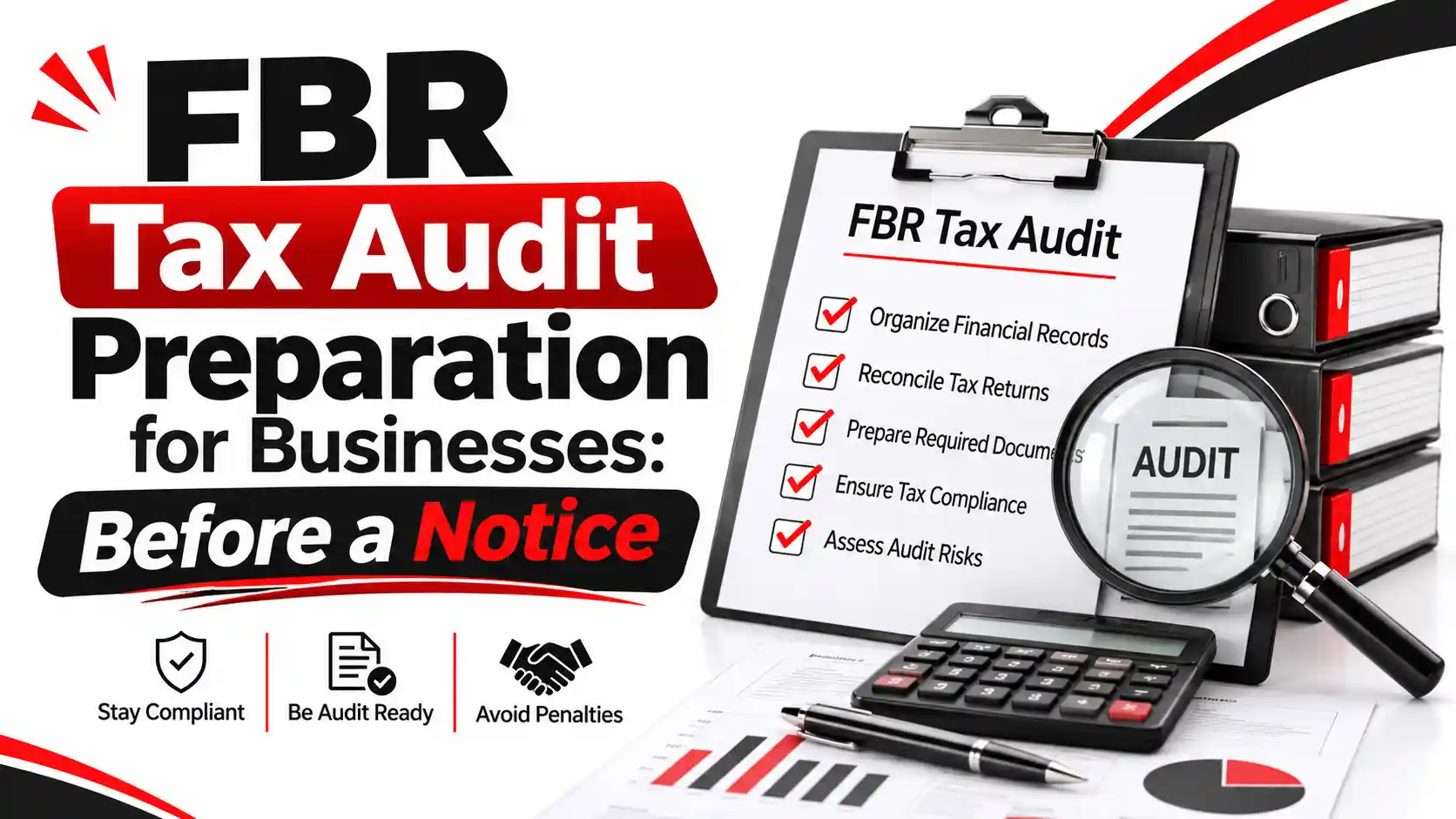
This guide explains the legal framework, the realistic triggers, record-retention rules, a step-by-step preparation plan, the documents to keep ready and the 2025–2026 changes that matter. It also covers what to do if a notice arrives anyway. Everything here supports a wider business tax compliance routine.
Quick Answer
To prepare for an FBR tax audit before a notice, reconcile your income tax and sales tax returns with your books and bank statements, verify withholding tax compliance, support every major expense and deposit with documents, retain records for six years, and fix errors early. Assign one owner and review quarterly.
Key Points
- Reconcile every period: match returns, financial statements, bank statements and invoices, following a monthly tax compliance checklist.
- Keep records for six years: the Income Tax Ordinance requires six years after the end of the relevant tax year, and longer while proceedings are pending. See our guide to digital accounting services for storing them.
- Support deposits and expenses: every large bank credit and major expense needs a document behind it, as explained in our guide to explaining source of income under Section 111.
- Correct errors early: use a revised return or rectification application instead of waiting to be asked. See revised return vs rectification.
- Treat readiness as a routine: assign one owner and run a mock audit each year, using the corporate compliance calculator as a quick check.
What Is an FBR Tax Audit and Who Conducts It?
An FBR tax audit is a formal examination of a taxpayer’s accounts, records and returns to check that declared income, expenses and tax payments are correct. Under the Income Tax Ordinance, 2001, audits happen either through a Commissioner’s reasoned selection or through a Board-run computer ballot. An audit is a verification exercise, not an accusation, and the steps for handling any tax notice start from that understanding.
How Does an Income Tax Audit Work Under Sections 177 and 214C?
Section 177 lets a Commissioner Inland Revenue call for records and audit a taxpayer’s income tax affairs. Section 214C lets the Board select persons or classes of persons through a computer ballot that may be random or parametric. The Board’s power and the Commissioner’s power operate independently, so selection by one does not rule out the other. Our guide to income tax filing for small businesses explains the returns an income tax audit examines.
How Does a Sales Tax Audit Work Under Sections 25 and 72B?
The sales tax track mirrors this. Section 25 of the Sales Tax Act, 1990 lets the Commissioner select a registered person for audit, and Section 72B covers Board-level ballot selection. FBR’s e-audit procedure under S.R.O. 1338(I)/2020 requires the registered person to produce the records kept under Section 22 through IRIS or an approved electronic data carrier. Federal Excise Act audits follow similar logic. Mistakes in sales tax returns are a leading source of audit questions, so it helps to know the common errors in sales tax filing.
| Feature | Income tax audit | Sales tax audit |
|---|---|---|
| Main law | Income Tax Ordinance, 2001 | Sales Tax Act, 1990 |
| Commissioner selection | Section 177 | Section 25 |
| Board ballot selection | Section 214C | Section 72B |
| Core focus | Declared income, expenses, withholding, assets | Output tax, input tax, invoices, refunds |
| Records kept under | Section 174 | Sections 22 and 24 |
For the basics of the second column, see our plain-language guide to sales tax in Pakistan.
Why Should a Business Prepare Before a Notice Arrives?
Preparing early gives you time. Time lets you find mismatches, correct genuine errors through proper channels and gather evidence calmly instead of under a deadline. A business that cannot produce records on request risks a best-judgement assessment, which is built on whatever information FBR already holds and is rarely favourable. The penalty provisions of the Ordinance also apply to non-compliance with statutory notices, and our guide on avoiding late-filing penalties shows how small lapses grow.
There are four practical benefits:
- Faster responses. Documents are already indexed and reconciled.
- Fewer surprises. You find the discrepancy before FBR’s data matching does, as covered in our guide to explaining source of income under Section 111.
- Lower stress and cost. Consultants spend less time reconstructing records.
- Better decisions. You can choose between correcting a return, defending a position or taking advice while options are still open.
Can FBR Audit a Business Without Prior Notice?
Audit proceedings under Sections 177 and 214C begin with a notice, usually served through IRIS. A business can still come to FBR’s attention without a formal audit notice, through other powers. These include a call for information under Section 176, withholding monitoring proceedings, and sales tax inquiry powers under Section 38 of the Sales Tax Act. Because of these other routes, a business should treat its records as always inspectable, whatever the label on the notice. Our overview of tax compliance in Pakistan sets out the wider obligations.
Practically, this means:
- Check your IRIS inbox regularly, using the FBR IRIS 2.0 features guide if the interface is unfamiliar.
- Keep your registered contact details current so notices actually reach you.
- Never assume that no formal audit means no scrutiny.
What Triggers an FBR Tax Audit in Pakistan?
Under Section 214C, ballot selection may be random or parametric, and the parameters are kept confidential by law. No outsider can give you a definitive list of triggers, and you should be sceptical of anyone who claims to have one. Commissioner-initiated selection under Section 177 and Section 25 depends on recorded reasons and available information. What follows are practical risk indicators from tax practice. They are our recommendations for self-review, not FBR’s published criteria.
Which Practical Red Flags Should You Review Yourself?
- Sales and income mismatches. Turnover in sales tax returns that differs from revenue in income tax returns is a classic discrepancy. Review it against a sales tax filing checklist.
- Withholding mismatches. Tax deducted by customers and banks should match your certificates and returns. Check rates against the FBR withholding tax rate chart for 2026-27.
- Persistent losses or unusually thin margins. Test your numbers with the net profit margin calculator and be ready to explain them.
- Large unexplained bank credits. Credits without matching sales or loan documents invite questions. Compare them with your wealth statement reconciliation.
- Cash-heavy sales. Retail and trading businesses should see the FBR POS integration requirements for Tier-1 retailers.
- Purchases from suppliers without NTNs. Verify supplier status through online NTN verification.
- Late filing or incorrect filer status. Check where you stand using our guide to late filer, non-filer and active filer status.
- Refund claims and unusual input tax. These warrant clean working papers, as explained in our guide to submitting sales tax returns.
- High-value property or asset purchases. Know the property tax rules under Sections 236C and 236K.
How Long Must Businesses Keep Records, and How Far Back Can FBR Look?
Section 174(3) of the Income Tax Ordinance requires taxpayers to keep accounts, documents and records for six years after the end of the relevant tax year. The Supreme Court has held that a taxpayer cannot be compelled to produce records for a tax year beyond that six-year period, as reported by Business Recorder. Records must be kept longer if proceedings are pending, and the six-year limit does not extend to records tied to certain unexplained income and asset matters under Section 111. A digitised archive makes this practical, and our guide to digital accounting services explains how to build one.
For sales tax, FBR’s records and retention guidance states that a registered person must maintain records and documents for six years after the end of the tax period to which they relate. Beyond retention, audit exposure also depends on how far back an assessment can be amended. Under Section 122, that is generally five years from the end of the financial year in which the return was filed, although you should confirm the current text in the Ordinance. Our guide to filing the income tax return in Pakistan explains how that filing date fixes the clock.
There is also protection against repeat selection. Business Recorder reported that the Finance Act 2025 redrafted the relevant clause so that a person whose income tax affairs were selected for audit in any of the preceding three tax years is immune from fresh selection under Sections 177 and 214C. The law contains exceptions, so confirm the current text. The tax filing deadline guide for 2026 helps you track which years fall inside each window.
How to Prepare for an FBR Tax Audit Before a Notice: Step by Step
This is the core of audit readiness. The sequence is our recommendation, built around the areas audits commonly examine. Adapt it to your size and sector. Our corporate tax planning strategies guide shows how this routine connects to wider planning.
Step 1: Appoint an Owner and Run a Mock Audit
Name one person, internal or external, responsible for audit readiness. Then run a mock audit: pick one tax year and try to produce every document that supports your return within a few days. The gaps you find define your work plan. The corporate compliance calculator gives a quick view of your compliance obligations.
Step 2: Reconcile Income Tax Returns With Financial Statements
Compare the revenue, cost of sales, expenses and profit in your return with your financial statements and trial balance. Confirm that the tax regime you used matches your actual circumstances, as explained in our comparison of the final and normal tax regimes. Where your business is an AOP or partnership, check that profit allocations and the return agree. If this step reveals complexity, professional annual income tax filing support for partnerships and companies can help.
Step 3: Reconcile Sales Tax Returns With Your Books
Compare output tax in sales tax returns with sales in your ledger and income tax return. Match input tax claimed with purchase invoices, and check that your suppliers are active and registered. Confirm that your return frequency and annexures are correct, using our guide to monthly versus quarterly sales tax filing. For the mechanics of the return itself, see the complete sales tax return guide. Businesses that want structured monthly support can look at our monthly sales tax return filing service.
Step 4: Verify Withholding Tax Compliance
Check that you deducted tax on payments where the law requires it, deposited it on time and filed the related statements under Section 165. Failure to deduct or deposit can create liability under Section 161, which makes this a frequent audit area. Compare the tax certificates you issue and receive with your ledgers. Our guide to withholding tax compliance mistakes lists the errors to look for, and our withholding statements filing service supports businesses that prefer outside help.
Step 5: Reconcile Bank Statements and Explain Every Major Credit
Prepare monthly bank reconciliations for every account used in the business. Then trace each large deposit to a sale, a loan, capital introduced or another documented source. Unexplained credits are the usual route into Section 111 proceedings on unexplained income or assets. Where owners’ personal assets are involved, align them with the wealth statement under Section 116.
Step 6: Support Every Major Expense and Purchase
Expenses need invoices, proof of payment and a clear business purpose. Two rules deserve special attention. The Finance Act 2025 inserted Section 21(s), which disallows 50 percent of the expenditure attributable to a sale above Rs 200,000 on a single invoice where payment is not received through a banking channel or digital means. Business Recorder reported this, including that cash deposited into the seller’s bank account is treated as a banking-channel payment. The same Act also introduced a 10 percent disallowance on expenditure attributable to purchases from persons without an NTN. Confirm the current wording in the Ordinance updated to 30 June 2026 before relying on either rule. Our guide on how to reduce tax liability legally in Pakistan explains which deductions are properly supportable.
Step 7: Tidy Payroll, Fixed Assets and Inventory
Reconcile payroll registers with salary withholding and certificates, as described in our guide to the salary tax certificate and employer NTN. Maintain a fixed asset register with purchase evidence and depreciation workings. For inventory, hold stock registers and year-end stock count records. Good software makes this far easier, and our comparison of accounting software for small businesses is a useful starting point.
Step 8: Document Loans, Related Parties and Company Records
Keep signed agreements, bank trails and board or partner approvals for director loans, shareholder loans and related-party transactions. Make sure your company filings, financial statements and tax returns tell the same story. Our guide to corporate tax in Pakistan covers the compliance cycle for companies.
Step 9: Secure Your IRIS Account and Contact Details
Confirm that you can log in, that your registered email and mobile number are current and that someone monitors the inbox. If you have not set up or recovered access, follow the IRIS registration guide. If access fails, our articles on IRIS login problems and recovering a forgotten IRIS password walk through the fixes.
Step 10: Correct Errors Before a Notice Arrives
If your review finds a genuine mistake, correct it through the proper route rather than hoping it goes unnoticed. Depending on the facts, that may be a revised return under Section 114(6) or a rectification application. Our comparison of a revised return and a rectification application explains which fits which situation. The guide to correcting mistakes in an FBR income tax return gives the practical steps, and the rectification application guide covers clerical and apparent errors.
Which Documents Should a Business Keep Ready for an FBR Audit?
The notice will list exactly what is required, but a ready-made file saves days. The table below is a practical checklist, not a statutory list. Our guide to tax compliance for small businesses explains how to organize it.
| Document | What it helps prove | Frequency of review |
|---|---|---|
| Income tax and sales tax returns, with challans | What you declared and paid | Each filing |
| General ledger, trial balance, cash book | The accounting trail behind the returns | Monthly |
| Financial statements | Profit, assets, liabilities and cash flow | Annual |
| Bank statements and reconciliations | Source of receipts and use of funds | Monthly |
| Sales invoices and purchase invoices | Output tax, input tax, revenue and cost | Ongoing |
| Withholding tax statements and certificates | Deduction, deposit and credit claims | Each period |
| Payroll records and salary certificates | Employee tax compliance | Monthly |
| Fixed asset and depreciation register | Capital expenditure and allowances | Annual |
| Stock registers and count sheets | Inventory and cost of sales | Periodic |
| Contracts, loan and related-party agreements | Substance of major transactions | On signing |
| Import and export documents | Customs and zero-rating support | Per shipment |
| Correspondence with FBR | History of notices and replies | Ongoing |
A short ATL status check and a copy of your registration documents belong in the same folder. Evidence of registration is covered in the documents required for NTN registration.
How Should Different Types of Business Prepare?
The core steps are the same, but the pressure points differ by business type.
- Trading and retail businesses: stock records, cash sales controls and invoicing discipline. See the FBR POS integration guide.
- Online sellers: platform statements, courier cash-on-delivery records and withholding on e-commerce receipts. Our guide to e-commerce tax rates and withholding explains the rates.
- Software houses and IT exporters: contracts, invoices and proof that export proceeds arrived through banking channels. See our guide to the best tax consultant for software houses and the PSEB registration and tax rate guide.
- Freelancers and agencies: client contracts, payout statements and remittance records, as covered in our income tax guide for freelancers.
- Startups: clean founder-funding records and early bookkeeping habits, as outlined in our guide to a tax consultant for startups in Pakistan.
- NGOs and non-profits: donor records, expense evidence and exemption documents. See NGO compliance requirements for 2026.
- Service providers under provincial laws: provincial sales tax on services is administered separately, so review the PRA registration guide for service providers or the SRB tax filing guide.
How Can Technology Make a Business Audit-Ready?
Technology turns audit readiness from a yearly scramble into a daily habit. Accounting software keeps a consistent audit trail, bank feeds speed up reconciliation, and digital storage makes six-year retention practical. IRIS is FBR’s portal for returns and notices, so your team should be comfortable using it. Our overview of digital invoicing under FBR rules explains registration, integration and penalties, which matter for any business subject to those requirements.
A few practical habits:
- Scan and index paper documents on receipt, using a naming convention that includes date, party and amount. See why incomplete initial records create long-term problems.
- Back up accounting data and keep access controlled.
- Use calculators for sense-checks, such as the withholding tax calculator and the sales tax calculator.
- Keep an authorised, qualified person on your IRIS account.
What Are the Latest Rules and Developments Affecting FBR Audits?
Several recent changes affect how audits work, so check each against the current law.
- Finance Act 2025: redrafted the audit-immunity clause for three tax years (discussed above) and introduced the cash-sale and non-NTN purchase disallowances under Section 21.
- Finance Act 2026 (enacted June 2026): introduced a faceless audit and assessment framework through Section 122E. As Business Recorder reported, it allows audit under Section 177 and later amendment proceedings to be conducted in a faceless manner as prescribed by the Board. The detailed procedure and the cases covered depend on Board rules and notifications, which have been rolling out in phases.
- Algorithmic settlement (Section 134B): a digitally operated mechanism that can offer a computed settlement before an assessment or amendment of assessment. Taxpayers who accept it can revise their return without separate Commissioner approval, but it does not prevent proceedings on other issues or years.
- Parallel sales tax measures: the Finance Bill proposed similar faceless and settlement provisions in the Sales Tax Act and Federal Excise Act. Confirm the final enacted text before relying on them.
- Consolidated law: FBR publishes the Ordinance as amended up to 30 June 2026 on its Income Tax Ordinance page. Always quote from the current version.
For the wider package of 2026-27 changes, read our summary of the top 10 tax changes in the 2026-27 budget. Because the faceless rollout is still evolving, Baco’s audit response guide is updated as the position changes.
What Is the Difference Between an FBR Tax Audit and a Tax Assessment?
An audit examines records and produces findings. An assessment formally determines or amends tax liability and can follow an audit. If an assessment order is wrong, the appeal route is explained in our guide to how to appeal a tax assessment.
What Is the Difference Between an Income Tax Audit and a Sales Tax Audit?
They run under different laws, records and officers, as the earlier table shows. A business registered for both should keep the two sets of returns reconciled to one set of books, which the sales tax registration process guide helps establish from the start.
What Is the Difference Between an Internal Audit and an FBR Audit?
An internal audit is your own check on controls and accuracy and has no legal force against you. An FBR audit is a statutory process with legal consequences. Treat your internal review as a mock version of the real thing, and note how technology is changing audit work.
What Is the Difference Between Tax Compliance and Tax Planning?
Compliance means filing correctly, paying on time and keeping records. Planning means arranging affairs lawfully to manage tax cost. Planning that is not backed by compliance and documentation tends to fail under scrutiny, as discussed in our guide to tax planning strategies for businesses.
What Is the Difference Between a Tax Consultant and a Chartered Accountant?
A chartered accountant is a member of the Institute of Chartered Accountants of Pakistan (ICAP), while “tax consultant” is a broader description used by several kinds of professionals. What matters is that your adviser is qualified to represent you before tax authorities and understands your sector. Our guide to the best tax consultant in Pakistan explains what to check.
What Happens If Your Records Do Not Match Your Tax Returns?
A mismatch is not automatically evasion, but it must be explained. First, find the cause: a timing difference, a classification error, a missing invoice or a genuine understatement. Then decide on the right fix. Clerical or arithmetic errors may be corrected through rectification. Substantive errors usually call for a revised return, subject to the conditions in the Ordinance. Our guide to common FBR return errors and IRIS bugs helps separate system problems from genuine mistakes.
If a mismatch is left unexplained, the risks include an amended assessment under Section 122, penalties under the Ordinance and, where deposits or assets are unexplained, proceedings under Section 111. If you disagree with the resulting order, the appeal ladder runs from the Commissioner (Appeals) to the Appellate Tribunal Inland Revenue and, on questions of law, to the High Court, as described in our tax appeal process guide.
What Are the Most Common Mistakes Businesses Make?
- Treating compliance as a year-end task. Monthly reconciliations prevent year-end surprises, and our guide to monthly tax return filing for businesses shows the rhythm.
- Claiming input tax without checking supplier status. Verify suppliers before claiming credit.
- Mixing personal and business transactions. This clouds the audit trail and invites Section 111 questions.
- Accepting large cash payments without documentation. See the Section 21(s) discussion above.
- Ignoring withholding obligations. Our guide on getting a tax withholding certificate online helps you keep both sides of the paper trail.
- Letting IRIS notices go unread. An unread notice does not stop the deadline.
- Not retaining records. Missing documents can lead to deductions being disallowed.
- Filing late and assuming it is harmless. Late filing has its own costs, which you can estimate with the late filing penalty calculator.
What Is a Realistic Audit-Preparation Timeline?
The following timeline is our recommendation for a typical small or medium business. Adjust it to your size and complexity. Our deadline guide for monthly tax filing helps you anchor it to the statutory calendar.
| Period | Focus | Output |
|---|---|---|
| Weeks 1–2 | Appoint owner, run mock audit on one tax year | Gap list |
| Weeks 3–4 | Reconcile income tax return with accounts; reconcile bank statements | Reconciliation files |
| Month 2 | Reconcile sales tax and withholding; review supplier and expense documentation | Exceptions register |
| Month 3 | Correct errors through revised return or rectification; index documents | Audit-ready folder |
| Every quarter | Repeat reconciliations; update registers and IRIS details | Updated file |
| Every year | Full mock audit; review law changes | Compliance review note |
How Ready Is Your Business? A Quick Self-Assessment
Answer yes or no. Each “no” is a task. This list supports our tax compliance health check approach.
- Do income tax revenue and sales tax turnover reconcile to your ledger?
- Are bank accounts reconciled monthly?
- Can you trace every large deposit to a documented source?
- Are withholding deductions deposited and statements filed?
- Do you hold invoices for all claimed expenses and input tax?
- Are suppliers verified as registered or NTN holders?
- Do cash sales above Rs 200,000 per invoice go through a banking channel?
- Is the wealth statement consistent with the business accounts?
- Are six years of records stored and retrievable?
- Can at least two people log in to IRIS and read notices?
- Are loans and related-party transactions supported by agreements?
- Do you know your filer status and tax regime?
What If an Audit Notice Arrives Anyway?
Preparation does not guarantee you will never be selected. It makes the response faster and safer. On receiving a notice, log in to IRIS to confirm it is genuine, note the section, tax year and deadline, list exactly what is requested, and answer each point with indexed evidence. Request more time in writing before the deadline if you genuinely need it. Our guides on responding to FBR notices and what to do after receiving an FBR tax notice walk through the full process.
If the case is complex, involves unexplained assets or carries a large potential liability, take professional advice early. Our FBR tax consultant services in Islamabad page describes the support available.
What Does Audit Preparation Cost?
There is no verified, fixed market price for audit preparation, because the work depends on the size of the business, the number of tax years, the condition of the records and the tax heads involved. Any figure quoted without seeing your books should be treated with caution. The more useful comparison is between the cost of orderly records now and the cost of reconstructing them under a deadline later. The late filing penalty calculator gives a sense of one avoidable cost, and our guide to income tax consultants in Islamabad explains what to ask before engaging an adviser.
Illustrative Example: A Trading Company Does a Mock Audit
This is a hypothetical scenario to show the method. It is not a real client case, and outcomes in real cases depend on the facts.
Imagine a trading company that wants to test its readiness for one tax year. The reviewer compares sales in the income tax return with turnover in monthly sales tax returns and finds a gap. Tracing it, the team discovers that some invoices were recorded in one system but not the other. They also find three large bank credits with no documents. One is a shareholder loan with no signed agreement. The company then drafts the missing agreement documents, records the loan properly, reconciles the two sales figures and, where a return needs changing, takes advice on a revised return. By the time any notice might arrive, the file shows the issue, the explanation and the correction. Our guide on how to correct mistakes in your FBR return covers the correction stage.
Why Choose Baco Consultants for FBR Tax Audit Preparation in Pakistan
Baco Consultants is a tax and corporate compliance firm based in Islamabad, and its published work covers the areas an audit examines: income tax, sales tax, withholding tax, NTN and sales tax registration, and notice and appeal procedures. You can read about the firm and its people on our About page, and our FBR tax consultant Islamabad page explains how we support clients dealing with FBR.
Our public guides on audit response, notice handling and tax filing services in Islamabad show how we approach compliance. We prefer organized records and early correction to last-minute defence.
Frequently Asked Questions
What is an FBR tax audit?
It is a formal examination of a taxpayer’s records to verify declared income, expenses and tax paid, conducted under Section 177 or 214C of the Income Tax Ordinance or under the Sales Tax Act. See our audit response guide.
How can a business prepare for an FBR tax audit?
Reconcile returns with books and bank statements, verify withholding compliance, support major transactions with documents, retain records and correct errors early. Our compliance checklist breaks this into routine tasks.
Can FBR audit a business without prior notice?
Audit proceedings under Sections 177 and 214C start with a notice, but FBR has other powers, such as calling for information and sales tax inquiries, that can reach a business without a formal audit. See tax compliance in Pakistan.
What triggers an FBR tax audit?
Ballot parameters under Section 214C are confidential, and Commissioners may select on recorded reasons. Common risk areas include mismatches between returns, unexplained deposits and withholding discrepancies. See common reasons for FBR notices.
What documents does FBR ask for during an audit?
Typically returns, ledgers, financial statements, bank statements, invoices, withholding records, payroll and asset records, though the notice lists the exact requirements. See the documents required for NTN registration for related registration papers.
How many years of tax records must businesses keep?
Six years after the end of the relevant tax year under Section 174(3) for income tax, and six years after the tax period for sales tax, with longer retention while proceedings are pending. See digital accounting services.
Can the same business be audited every year?
Generally not. A person selected for audit in any of the preceding three tax years is immune from fresh selection under Sections 177 and 214C, subject to exceptions in the law. See how to appeal a tax assessment if an audit ends badly.
How far back can FBR amend an assessment?
Generally five years from the end of the financial year in which the return was filed, though you should confirm the current text of Section 122. See the income tax return filing guide.
What is the difference between an income tax audit and a sales tax audit?
They fall under different laws, records and selection sections: Sections 177 and 214C for income tax, Sections 25 and 72B for sales tax. See the sales tax guide.
What happens if my records do not match my returns?
Find the cause, then correct it through a revised return or rectification where appropriate. Unexplained gaps risk amended assessment, penalties and Section 111 proceedings. See revised return vs rectification.
What is the Section 21(s) cash-sale rule?
It disallows 50 percent of expenditure attributable to a sale above Rs 200,000 on a single invoice where payment is not received through a banking channel or digital means. Confirm the current text. See reducing tax liability legally.
What is the faceless audit system introduced in 2026?
The Finance Act 2026 introduced Section 122E, allowing audit under Section 177 and later amendment proceedings to be conducted in a faceless manner as prescribed by the Board. Rollout is phased. See the top tax changes in the 2026-27 budget.
What is algorithmic settlement under Section 134B?
A digital mechanism that can offer a computed settlement before assessment or amendment of assessment. Accepting it does not stop proceedings on other issues or years. See our audit response guide.
Do I need a consultant to prepare for an FBR audit?
Not legally, but professional review helps with complex records, multiple tax heads or large transactions. See the best tax consultant in Pakistan.
What should I do if I receive an FBR audit notice?
Verify it on IRIS, note the deadline, answer each request with indexed evidence and seek time in writing if needed. See how to respond to FBR notices.
Conclusion
Preparing for an FBR tax audit before a notice comes down to routine. Keep your income tax and sales tax returns reconciled to your books, support deposits and expenses with documents, stay current on withholding, retain records for the required period and correct genuine errors early. The 2026 faceless and settlement reforms make accurate, well-indexed records more valuable still. For the wider picture, our business tax compliance guide shows how these habits fit together.
If you would like your records reviewed before FBR asks for them, speak to the Baco Consultants team about a structured audit-readiness review. You can also see how we support clients through tax filing services in Islamabad.
Related Articles


Leave a Comment
No approved comments yet. Be the first to share your thoughts!