
Quick Answer
Section 114C of Pakistan's Income Tax Ordinance, 2001, inserted by the Finance Act 2025, bars an "ineligible person" from four high-value economic transactions: buying or registering a motor vehicle above Rs 7 million, transferring immovable property above Rs 100 million, holding securities or mutual fund investments above Rs 50 million, and withdrawing more than Rs 100 million cash annually. An eligible person is one who filed last year's income tax return and declared sufficient resources.
Legal Status Notice (Read This First)
As of 8 September 2026, Section 114C sits on the statute book, but sub-section (7) provides that the restrictions "shall come into force on such date as the Federal Government may, by notification in the official Gazette" specify. No such commencement notification has been publicly traced at the time of writing. In practical terms: the law is real, the thresholds are fixed, the enforcement switch has not yet been flipped. Anyone planning a large transaction in the next twelve months should treat compliance as urgent rather than optional, and should confirm the live position with the Federal Board of Revenue before committing funds. For a broader view of what changed this year, see our summary of the top tax changes in Pakistan's Budget 2026-27.
Introduction
If you are planning to buy a car, transfer a plot, or move a large sum through your bank account in Pakistan, one provision of the tax law now sits between you and that transaction. It is Section 114C. And most people who will be affected by it have never read a single line of it. At BACO Consultants, our corporate, tax and legal advisory team in Islamabad has spent the past year fielding the same question from clients across the country: "Will FBR actually stop my purchase?" The honest answer is layered, and it depends entirely on a definition most taxpayers have never encountered. If you want the foundations first, start with our complete guide to filing an income tax return in Pakistan, then come back here — or simply talk to our team directly.
Here is what makes Section 114C different from every non-filer measure that came before it. Older provisions punished you. They charged you a higher withholding rate, doubled your capital gains tax, or slapped a penalty on your return. Section 114C does something else entirely. It removes your ability to complete the transaction at all. A manufacturer cannot process your booking. A sub-registrar cannot attest your transfer deed. A broker cannot maintain your account. This is not a price signal — it is a gate. Understanding the difference between a penalty and a prohibition is the whole point of this guide, and it is why our clients treat tax compliance in Pakistan as an operational risk rather than an annual chore.
This article covers everything the law actually says, everything it is widely reported to say but does not, and the practical steps that move you from the wrong side of the gate to the right side. We have kept the statutory language precise and flagged the areas where genuine professional disagreement exists. Where a figure could change, we have said so. If you would rather have a specialist handle this end-to-end, our annual income tax filing services for salaried individuals are the fastest route to eligibility.
Need help right now? Book a Free Consultation with BACO Consultants →
Key Takeaways
- Section 114C creates a new legal category — "eligible" vs "ineligible" person — which is not the same thing as filer vs non-filer. You can be on the Active Taxpayer List and still be ineligible for a specific transaction. Understand the difference in our guide to filer vs non-filer in Pakistan.
- Four thresholds only (Fifteenth Schedule): vehicles above Rs 7 million, immovable property above Rs 100 million, securities/mutual funds above Rs 50 million, and annual cash withdrawals above Rs 100 million.
- The enacted law does NOT ban non-filers from opening ordinary bank accounts. That proposal appeared in the Tax Laws (Amendment) Bill, 2024, and in a lot of news coverage — it did not survive into the Finance Act 2025 text.
- Two routes to eligibility: file last year's return with sufficient resources declared, or file a Sources of Investment and Expenditure Statement on the FBR portal for the specific transaction.
- Immediate family counts. For an individual, "eligible person" includes parents, spouse and dependent children — a genuinely important planning lever.
- Non-residents and public companies are carved out of three of the four restrictions. The cash withdrawal cap still applies to them.
- Filing the sources statement does not trigger Section 111. The law expressly says so. Read more on explaining source of income under Section 111.
What Is Section 114C of the Income Tax Ordinance, 2001?
Section 114C is a provision titled "Restriction on economic transactions by certain persons," inserted into the Income Tax Ordinance, 2001, by the Finance Act 2025. It prohibits designated third parties — car manufacturers, vehicle registering authorities, property registration authorities, investment account providers and banking companies — from accepting or processing four categories of high-value transaction for a person the law calls "ineligible."
The structural design is what makes it powerful. Section 114C does not primarily create an obligation for you. It creates a legal bar on the intermediary. A motor vehicle manufacturer is told that an application from an ineligible person "shall not be accepted or processed." The authority responsible for registering, recording or attesting a property transfer is told the same. That shifts the enforcement burden away from the tax department and onto commercial gatekeepers, which is precisely why the provision has taken so long to switch on — the systems those gatekeepers need in order to check your status did not exist. If you are unfamiliar with how FBR's underlying registration architecture works, our step-by-step FBR IRIS registration guide is a useful primer.
The section is supported by a brand-new Fifteenth Schedule to the Ordinance, which carries the numeric thresholds. Keeping the numbers in a schedule rather than in the section body is deliberate: the Federal Government can revise them without a fresh Finance Act. That flexibility cuts both ways — thresholds can be raised to soften the impact, or lowered to widen the net. Anyone building a long-term plan around today's figures should build in headroom. Our tax planning strategies for businesses explain how to structure for regulatory drift rather than a single snapshot in time.
One more foundational point. Section 114C does not levy a single rupee of tax. It is a documentation and enforcement provision, not a charging provision. That distinction matters when you are assessing risk, because the consequences of falling foul of it are transactional and commercial — a blocked purchase, a collapsed deal, a forfeited booking deposit — rather than a tax demand you can dispute through the tax appeal process in Pakistan.
Why Was Section 114C Introduced? The Policy Logic
Section 114C exists because Pakistan's traditional non-filer penalties failed. For years the state charged non-filers higher withholding rates and, in effect, monetised non-compliance rather than ending it. Section 114C replaces the surcharge model with a denial-of-access model.
Think of it as the difference between a toll and a barrier. Under the withholding regime, a non-filer buying property simply paid more — up to 18.5% advance tax under Section 236K at the top slab, compared to a far lower rate for an active filer. That is expensive, but it is payable, and for someone with undocumented wealth it was often a rational cost of staying invisible. Our breakdown of the benefits of becoming a tax filer in Pakistan sets out just how wide that rate gap became.
The second policy driver is financial capacity matching. Section 114C is not merely asking "did you file?" It asks "does what you filed support what you are about to buy?" A person can file a return declaring Rs 800,000 of income and Rs 1.2 million of net assets, appear perfectly on the Active Taxpayer List, and then buy a Rs 90 million commercial unit. Under the old law that mismatch was addressed after the fact, through audit and Section 111 proceedings. Section 114C attempts to address it before the transaction closes. If you have ever received a notice about exactly this kind of gap, our guide on how to handle tax notices from FBR walks through the response.
The third driver is data. The Finance Act 2025 also inserted Section 175AA, empowering FBR to share taxpayer declaration data with scheduled banks for algorithmic cross-matching, with banks obliged to report variances back. Section 114C is the enforcement arm; Section 175AA is the intelligence arm. Read together, they describe a system in which your declared financial profile and your actual banking behaviour are continuously compared. Businesses that have historically kept two sets of numbers should read our note on business tax compliance in Pakistan with fresh attention.
Who Is an "Eligible Person" Under Section 114C?
An eligible person is someone who has either (a) filed an income tax return for the tax year immediately preceding the year of the transaction AND has sufficient resources declared in their wealth statement (individuals) or financial statements (companies and AOPs), or (b) filed a Sources of Investment and Expenditure Statement on FBR's web portal declaring sufficient resources and explaining them for that specific transaction.
Read the two limbs carefully, because they are alternatives, not cumulative conditions. Limb (a) is the standing route — you are permanently transaction-ready because your annual compliance is in order. Limb (b) is the transaction-specific route — a one-off declaration made for a particular purchase or investment. Limb (b) exists precisely for the person who has money, can prove where it came from, but whose last wealth statement does not happen to show a matching liquid balance. If your wealth statement is where the problem lies, our Section 116 wealth statement reconciliation guide is the place to start.
Note the precise timing language in limb (a): the return must be for "the tax year immediately preceding the year of the transaction." This is not the same as being on the current ATL, and it is not satisfied by having filed some return at some point. If you transact in the financial year following tax year 2026, it is the tax year 2026 return that matters. Missing that specific year breaks the chain even if every other year is clean. Track your dates against our Pakistan tax filing deadline guide.
For companies and associations of persons, the test runs off the financial statements attached with the income tax return for the latest tax year rather than a wealth statement. That places real weight on how the balance sheet is prepared — specifically, on the cash and cash-equivalent line items. A company with genuine liquidity buried in a poorly presented set of accounts can fail a test it should pass. If your corporate filings need tightening before a major acquisition, our annual income tax filing service for partnerships and companies covers exactly this.
Not sure which limb applies to you? Get a Section 114C Eligibility Review →
Who Is an "Ineligible Person"?
An ineligible person is defined negatively: anyone who is not an eligible person. There is no separate list, no register, and no notice — ineligibility is simply the residual state of failing the eligibility test at the moment of the transaction.
This negative definition has a practical consequence that catches people off guard. You will not receive a letter telling you that you are ineligible. There is no appeal against a status that was never formally assigned. You discover it at the showroom counter or the registrar's office, when the application will not go through. That is very different from the notice-driven process most taxpayers are used to, described in our overview of common reasons for FBR notices in Pakistan.
Three distinct groups fall into ineligibility, and they need different fixes. Group one are genuine non-filers who have never entered the system — for them the answer is NTN registration followed by a return. Group two are lapsed filers who filed in earlier years but missed the immediately preceding year — for them the answer is a late return, accepting the consequences covered in our guide on avoiding late tax filing penalties. Group three are the surprising ones: fully compliant filers whose declared liquid resources simply do not stretch to the transaction. Group three is the largest and least prepared.
Salaried professionals are especially exposed in group three. A senior executive may file flawlessly every year, sit comfortably on the Active Taxpayer List, and still show modest cash balances because savings sit in property, an inherited plot, or a family business rather than in a bank. Their wealth statement is accurate. It is just not liquid. Reviewing this before you shortlist a car — not after you pay the booking amount — is the single highest-value hour you can spend, and our income tax filing service for salaried individuals builds that review into the annual cycle.
What "Sufficient Resources" Means — The 130% Rule Explained
Section 114C defines "sufficient resources" as one hundred and thirty percent of the cash and equivalent assets declared by the person. Cash and equivalent assets are defined to include cash in local or foreign currency, the fair market value of gold, the net realizable value of stocks, bonds, receivables, and any other cash equivalent asset that may be prescribed.
Here is where you need to be careful, because this definition is drafted in a way that has produced genuine disagreement among Pakistani tax professionals. The literal statutory words define sufficient resources as 130% of your declared cash and equivalents — meaning a person with Rs 10 million of declared liquid assets has "sufficient resources" of Rs 13 million, a 30% cushion above what they actually hold. Several major professional firms, however, have summarised the provision as requiring liquid resources equal to 130% of the transaction value — the stricter reading. Our advice to clients has been consistent: plan to the stricter interpretation, because being over-prepared costs nothing and being under-prepared costs you the transaction.
The asset-exchange proviso is the most underused relief in the whole section, and almost no published commentary explains it properly. Where an asset covered by the vehicle, property or securities restrictions is purchased by way of exchange of capital assets already declared in your wealth statement, financial statement or sources statement, the disposal of those capital assets is treated as part of your cash-equivalent assets, to the extent of the value stated in the agreement. In plain terms: if you are selling a declared plot to buy a declared-value house, the sale proceeds count as liquid resources for the eligibility test. This is why proper capital gains computation and clean historical declarations matter far more than most taxpayers realise.
Note also which assets do not count. Your house, your car, your undeclared foreign holdings, and — critically — a plot you never declared are not cash equivalents. The definition is deliberately narrow, targeting liquidity rather than net worth. A person with Rs 500 million of real estate and Rs 2 million of cash may be wealthy and still fail. If your declared position needs correcting before you rely on it, read how to correct mistakes in an FBR income tax return.
Want your resources tested against a planned transaction? Request a Sufficiency Assessment →
The Fifteenth Schedule: All Four Thresholds in One Table
The Fifteenth Schedule to the Income Tax Ordinance, 2001, headed "Threshold for Economic Transactions," sets out four transaction types and their corresponding limits. Below these limits, Section 114C does not engage at all — an ineligible person may transact freely.
| # | Statutory Reference | Transaction | How Value Is Measured | Threshold (Ineligibility Bites Above This) |
|---|---|---|---|---|
| 1 | 114C(1)(a) | Booking, purchase or registration of a motor vehicle | Invoice value for locally manufactured vehicles; import value as assessed by Customs, inclusive of all applicable taxes, duties, levies and charges, for imported vehicles | Exceeding Rs 7,000,000 |
| 2 | 114C(1)(b) | Registering, recording or attesting transfer of any immovable property | Fair Market Value as defined in clause (22AA) of Section 2 of the Ordinance | Exceeding Rs 100,000,000 |
| 3 | 114C(1)(c) | Investment in securities, debt securities, units of mutual funds or money market instruments | Acquisition cost. The Rs 50m must represent new investment in a financial year, excluding reinvestment from liquidation of similar securities or reinvestment of returns on already-held securities | Exceeding Rs 50,000,000 |
| 4 | 114C(1)(d) | Annual cash withdrawal | Aggregate cash withdrawn | Rs 100,000,000 across all bank accounts held by an individual |
Two structural points are worth pausing on. First, thresholds 1 to 3 use the word "exceeding", which means a transaction at exactly the threshold figure is outside the restriction. A vehicle invoiced at precisely Rs 7,000,000 is not caught; one invoiced at Rs 7,000,001 is. That is a narrow margin to plan against, but it is real, and it will produce arguments at showroom counters. Second, threshold 4 aggregates across all accounts held by an individual, which makes account-splitting useless as a strategy — and, combined with Section 175AA data sharing with banks, technically enforceable.
Because these figures sit in a schedule rather than the section, the Federal Government can revise them by notification. Treat the table above as the position as at 8 September 2026 and re-check before any transaction near a boundary. Our FBR tax calculator for Pakistan 2026-27 is updated as thresholds change.
Restriction 1 — Motor Vehicles Above Rs 7 Million
An ineligible person's application for the booking, purchase or registration of a motor vehicle valued above Rs 7 million shall not be accepted or processed by any motor vehicle manufacturer or by the vehicle registering authority of the Excise and Taxation Department.
Notice how early in the chain this bites. The restriction covers booking, not just registration. That means the block operates at the manufacturer's order desk, months before the vehicle exists. A buyer who places a booking, pays a deposit, waits through a delivery queue and only then discovers an eligibility problem has a commercial dispute on their hands as well as a tax one. Anyone planning a purchase in this bracket should settle their status before they part with a booking amount, not after. Our guide to Islamabad vehicle registration fees and taxes for 2026-27 covers the downstream costs once the purchase clears.
The valuation rule differs by origin, and this creates an asymmetry that will reshape buying behaviour. For a locally manufactured vehicle, the measure is the invoice value. For an imported vehicle, it is the import value as assessed by the Customs Authority, inclusive of all applicable taxes, duties, levies and charges. Because Pakistan's duty structure on imported vehicles is heavy, an imported car with a modest landed cost can cross Rs 7 million on a duty-inclusive basis while a locally assembled equivalent stays below it. Two comparable cars, two different answers.
What the restriction does not cover is equally important. Section 114C(1)(a) addresses booking, purchase and registration. A transfer of an already-registered used vehicle between private parties is not, on the face of the clause, the same act as "booking, purchase or registration" of a motor vehicle — though the inclusion of "registration" leaves room for the argument that a transfer requiring fresh registration entries is caught. Until FBR clarifies administratively, treat high-value used-car transfers as an area of live risk and read our Islamabad car transfer guide for the procedural side.
Practically, the Rs 7 million ceiling sits well above the mass market and squarely on mid-to-large SUVs, executive sedans and most imported vehicles. Commentators have warned this could push demand toward the used market and toward sub-threshold models. If you are structuring a company vehicle policy around this, our corporate tax planning strategies note is a useful companion.
Buying a vehicle above Rs 7 million this year? Confirm Your Eligibility First →
Restriction 2 — Immovable Property Above Rs 100 Million
An ineligible person's application or request to any authority responsible for registering, recording or attesting the transfer of immovable property with a fair market value exceeding Rs 100 million shall not be accepted or processed by that authority.
The measuring stick here is Fair Market Value as defined in clause (22AA) of Section 2 of the Ordinance — not the declared sale consideration, and not the DC rate. This is the single most consequential detail in the clause, because it removes the traditional workaround of under-declaring consideration on the transfer deed. If FBR's notified valuation for the property exceeds Rs 100 million, the restriction engages regardless of what the parties wrote on the instrument. Our guide to property tax in Pakistan 2026-27 under Sections 236C and 236K explains how FBR valuation tables interact with transaction pricing.
The obligation falls on "any authority responsible for registering, recording or attesting transfer" — deliberately broad drafting that reaches sub-registrars, development authorities, housing societies performing transfer functions, and cooperative bodies. It is not limited to the formal land registry. Anyone whose institutional act completes a property transfer is potentially within scope, which is exactly why the provision's commencement has been tied to systems readiness across NADRA, provincial excise departments and land authorities.
At Rs 100 million, this restriction targets a narrow band: prime commercial plots, large agricultural holdings, high-end farmhouses and premium residential units in top-tier localities. Ordinary residential transactions are far below it. That said, the threshold sits in a schedule that can be revised downward by notification, and property values in Pakistan's major cities have a habit of climbing into thresholds set years earlier. Long-horizon investors should not treat Rs 100 million as permanently comfortable. Our note on Section 7E being abolished for tax year 2026-27 shows how quickly the property tax landscape moves.
There is an important interaction with the asset-exchange proviso discussed earlier. A seller disposing of a declared property to fund the purchase of another can count those proceeds as cash-equivalent resources, provided the outgoing asset was already declared. This makes property-to-property upgrades far more workable than a plain reading of the section suggests — but only for people whose historical declarations are clean. If yours are not, the revised return versus rectification application question needs answering before you list anything.
Planning a high-value property transfer? Speak to a BACO Property Tax Advisor →
Restriction 3 — Securities and Mutual Funds Above Rs 50 Million
Any person authorised to open and maintain an account in respect of securities, units of mutual funds or similar investments shall not open or maintain such an account if the total investment by an ineligible person in that account exceeds Rs 50 million.
This clause is drafted differently from the first two, and the difference matters enormously. It restricts not just opening but maintaining the account. That is a continuing obligation, not a one-time gate. A brokerage, asset management company or custodian is required to keep assessing status, which converts the restriction from a checkpoint into a monitoring duty. An investor who was eligible when they opened the account but who misses a subsequent year's return has a live problem.
The Fifteenth Schedule adds a carve-out that most summaries omit entirely. The Rs 50 million figure applies to the acquisition cost of securities, debt securities, units of mutual funds or money market instruments, subject to the condition that the amount up to Rs 50 million must be new investment in a financial year, excluding reinvestment either by liquidation of similar securities or reinvestment of returns earned on already-held securities. In practice: churning an existing portfolio does not count toward the threshold, and neither does ploughing dividends and profits back in. Only genuinely new money counts. That is a far more investor-friendly rule than the headline number suggests.
The threshold is also per financial year, which introduces a timing dimension absent from the vehicle and property restrictions. A person deploying Rs 90 million of new capital could, in principle, stay below the annual limit by spreading it across two financial years — though anyone contemplating that should be confident it is a genuine investment schedule rather than an artificial split, given FBR's general anti-avoidance posture. Our tax savings calculator can help model the timing.
For the capital markets, the significance is structural. Pakistan has spent years trying to widen retail participation in the stock market and mutual funds. Section 114C(1)(c) applies a documentation filter at the Rs 50 million level, which is high enough to leave genuine retail investors untouched while catching the undocumented high-net-worth money that has historically moved in and out of the market. Investors managing portfolios at this scale should read our note on reducing tax liability in Pakistan alongside their broker's advice.
Restriction 4 — Annual Cash Withdrawal Above Rs 100 Million
A banking company shall not allow annual cash withdrawal from any bank account of any person exceeding Rs 100 million. The Fifteenth Schedule measures this as Rs 100 million across all bank accounts held by an individual in a year.
This is the one restriction that applies to everyone. The carve-out that protects non-residents and public companies from the vehicle, property and securities restrictions expressly does not extend to cash withdrawals. A non-resident Pakistani, a listed company, and a domestic non-filer are all subject to the same Rs 100 million annual ceiling. If you are an overseas Pakistani assessing your exposure, our tax rules for overseas Pakistanis guide covers the wider picture.
The aggregation across all accounts is what gives the rule teeth. Splitting withdrawals across five banks does not create five ceilings; it creates one, and Section 175AA gives FBR the data-sharing mechanism to see the aggregate. This is a meaningful shift for cash-intensive sectors — commodity trading, construction, wholesale distribution, livestock and agricultural procurement — where large cash movements have been normal business practice rather than evasion. Businesses in these sectors should be documenting the commercial rationale for cash usage now, and our monthly tax compliance checklist for businesses is a practical starting point.
Do not confuse this restriction with the separate advance tax on cash withdrawals under Section 231AB, which the Finance Act 2025 increased from 0.6% to 0.8% on daily cash withdrawals exceeding Rs 50,000 by persons not appearing on the Active Taxpayer List. Section 231AB is a tax; Section 114C(1)(d) is a prohibition. They operate at completely different levels and on completely different triggers — Rs 50,000 daily for the tax, Rs 100 million annually for the block. Both can apply to the same person on the same day. Use our withholding tax calculator to model the 231AB cost.
Finally, note the drafting: the obligation is on the banking company not to allow the withdrawal. The bank is the enforcement point. That is why implementation depends on banking-sector systems being able to compute a running annual aggregate per CNIC across the institution — infrastructure that had to be built before the provision could sensibly commence.
Running a cash-intensive business? Get a Cash Flow Documentation Review →
Can Non-Filers Still Open Bank Accounts? The Biggest Myth About Section 114C
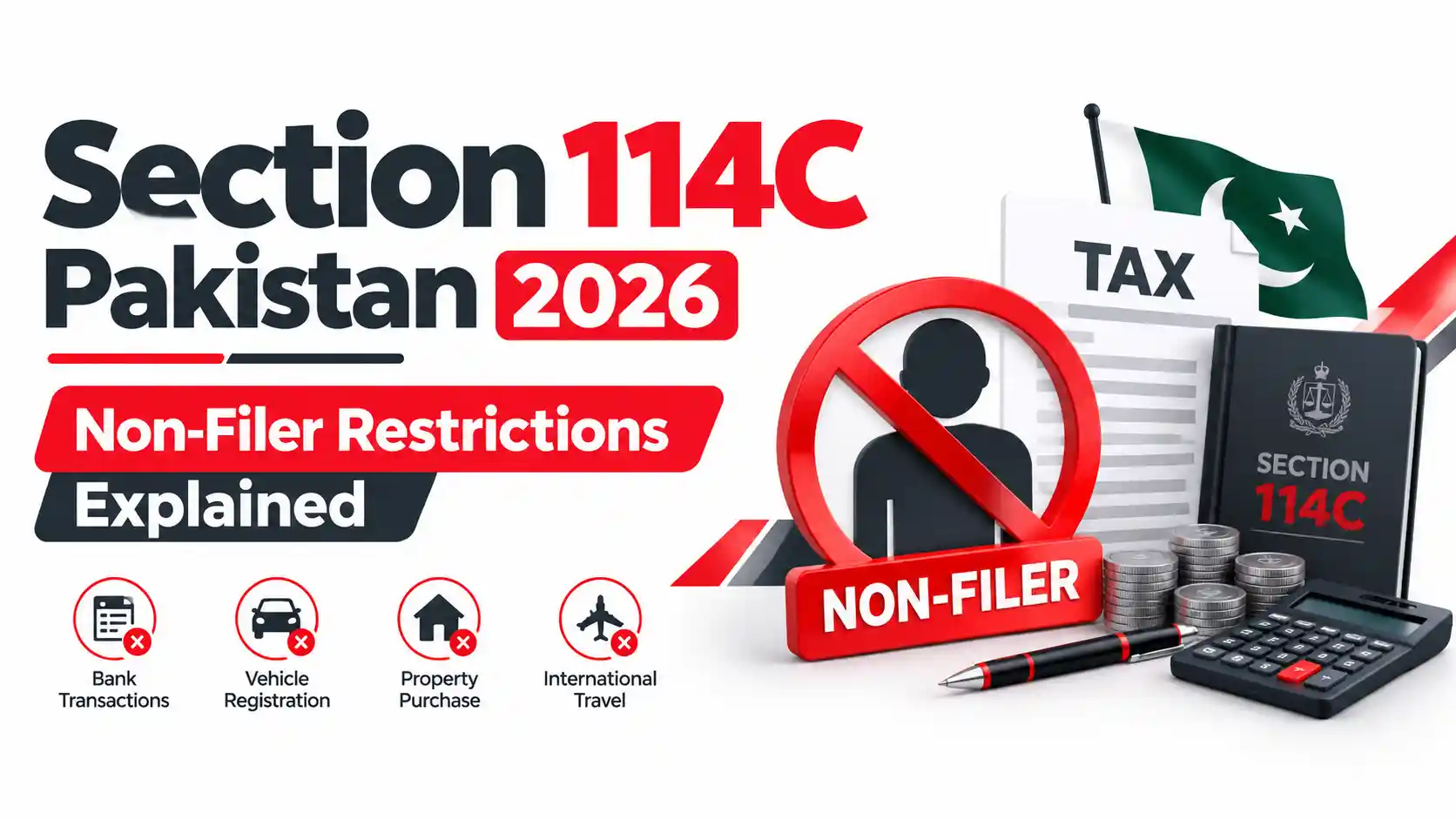
Yes. The enacted Section 114C does not prohibit an ineligible person from opening or maintaining an ordinary bank account. That proposal appeared in the Tax Laws (Amendment) Bill, 2024, and in extensive news coverage of the Finance Bill 2025, but it is not in the four restrictions the Finance Act 2025 actually enacted.
This deserves its own section because the misinformation is everywhere. Search almost any Pakistani tax blog for Section 114C and you will find confident statements that non-filers cannot open bank accounts except "Asaan Accounts," or that the restriction applies to all accounts "except savings accounts." Those descriptions trace back to the draft stages of the legislation and to reporting on the Finance Bill before it was amended. The enacted section's account restriction, at clause (c), is confined to securities, mutual fund and similar investment accounts above Rs 50 million — not deposit accounts. If you have been avoiding banking on the strength of that rumour, read our guide to FBR registration requirements in Pakistan and reconsider.
Why does this matter beyond correcting the record? Because acting on the myth causes real harm. People who believe they cannot bank push more activity into cash, which increases their Section 231AB withholding, worsens their documentation position, and moves them closer to — not further from — the problems Section 114C was designed to surface. The rational response to Section 114C is more banking, not less. Our note on small business accounting in Pakistan makes the same argument from an operational angle.
To be clear about what does affect bank accounts: the Rs 100 million annual cash withdrawal cap under clause (d), the higher 0.8% advance tax under Section 231AB for non-ATL persons, and the FBR–bank data exchange under Section 175AA. Those are real. An account-opening ban is not. Check your own standing first using our guide on how to check the Active Taxpayer List in Pakistan.
Who Is Exempt from Section 114C?
Section 114C expressly provides that the restrictions do not apply to transactions made by a non-resident person or a public company — except for the annual cash withdrawal restriction under clause (d), which applies to everyone.
The non-resident exemption is significant for the Pakistani diaspora. A non-resident individual can register property above Rs 100 million, book a vehicle above Rs 7 million, and hold securities above Rs 50 million without engaging Section 114C at all. But the exemption turns entirely on genuinely holding non-resident status under Pakistan's residence rules — not on holding a foreign passport or living abroad informally. If your residence position is untested, read how to become a non-resident taxpayer in Pakistan before relying on it.
The public company exemption reflects a sensible policy judgement: listed entities with audited accounts, regulatory oversight and public disclosure obligations are already documented. Note the term is "public company" as defined in the Ordinance, which is narrower than "large company." A substantial private limited company enjoys no exemption at all, no matter how big it is. Owners of large private groups should confirm their classification — our private limited company registration guide covers the structural distinctions.
There is also an implicit exemption of enormous practical importance: every transaction below the thresholds. Section 114C is not a general non-filer regime. A non-filer buying a Rs 4 million car, transferring a Rs 30 million house, investing Rs 20 million in mutual funds and withdrawing Rs 40 million in cash over a year is entirely outside Section 114C. They will still pay elevated withholding rates as a non-ATL person — see our comparison of late filer vs non-filer vs active filer — but no transaction gets blocked.
Finally, and importantly, Section 111 immunity. The law expressly provides that the sources of investment and expenditure statement filed under Section 114C, and the sufficient resources declared in it, shall not be construed as nature and source of income for the purposes of Section 111 (unexplained income and assets). Filing the statement does not, of itself, hand FBR a Section 111 case. This is a deliberate confidence-building measure, and it is the single most misunderstood safeguard in the provision. Our detailed treatment of Section 111 wealth reconciliation explains why that protection is narrower than it first appears.
The Immediate Family Rule: The Most Useful Provision Nobody Uses
For an individual, the definition of "eligible person" expressly includes their immediate family members, defined as parents, spouse and dependent children. This means a person's eligibility can be established by reference to the declared resources of their immediate family.
This is the most practically valuable clause in Section 114C and the least discussed. A young professional with limited declared liquidity but compliant, well-documented parents is not automatically shut out of a Rs 8 million car purchase. A homemaker whose spouse files comprehensively is not automatically barred from a property transfer. The provision recognises how Pakistani households actually finance major purchases — collectively, across generations — rather than imposing an individualistic model that would fail in practice.
Three boundaries deserve attention. First, the definition is closed: parents, spouse, dependent children. Siblings are not included. Adult independent children are not included. Uncles, cousins and in-laws are not included, however central they may be to a family business. Second, "dependent" qualifies children specifically, which imports a factual test. Third, and most importantly, relying on family resources only helps if those family members' own declarations are complete and current. A parent who has never filed brings nothing to the table. This is precisely why our family and closely-held business advisory work treats the household as the planning unit rather than the individual.
The practical implication is a compliance strategy most families have never considered: file for everyone. A retired father with pension income below the taxable threshold may see no reason to file. Under Section 114C, his nil tax return and wealth statement could be the document that unlocks his son's property purchase three years from now. The cost of filing is trivial. The cost of not having filed, at the moment a transaction is blocked, is not.
Want your whole family's filings brought current? Book a Household Compliance Review →
Sources of Investment and Expenditure Statement — Step by Step
The Sources of Investment and Expenditure Statement is a declaration filed by a person on FBR's web portal specifying the sources of funds for a particular transaction. It is the alternative route to eligibility for taxpayers whose last wealth statement does not show sufficient liquid resources for the transaction they are planning.
Understanding when to use this route is the whole skill. The wealth statement route works if your annual filings already carry enough declared liquidity. The sources statement route works when they do not — because your money arrived after your last filing, because it came from a declared asset disposal, or because it was always documented but never sat as cash on your statement date. Anyone whose finances do not fit neatly into an annual snapshot should know this route exists.
Step 1 — Confirm the transaction is actually within scope. Check the value against the Fifteenth Schedule. Below threshold, no statement is needed. Do this before anything else; a surprising number of people prepare declarations for transactions that were never restricted. Verify current thresholds against the Federal Board of Revenue's official portal.
Step 2 — Test the wealth statement route first. Pull your last filed wealth statement and total your declared cash, foreign currency, gold at fair market value, and net realizable value of stocks, bonds and receivables. If that supports the transaction, you may not need a sources statement at all.
Step 3 — Assemble documentary evidence for every rupee. Bank statements showing the inflow, sale agreements for disposed assets, remittance advices for foreign inflows, loan agreements, inheritance documentation, dividend and profit records. The statement asks you to specify sources; a specification without evidence behind it invites the audit you were trying to avoid.
Step 4 — Apply the asset-exchange proviso where relevant. If you are funding the purchase by disposing of a previously declared capital asset, the disposal value stated in the agreement counts as a cash equivalent. Document the chain from declared asset to sale agreement to purchase.
Step 5 — File on the FBR web portal before the transaction. The statement is transaction-specific and forward-looking. Filing after your application has been rejected does not retrospectively rescue the transaction. Build the timeline into your deal schedule. If you have hit IRIS 2.0 login or filing errors, resolve them well in advance.
Step 6 — Retain the evidence file. Section 111 immunity attaches to the statement, but that immunity is a shield against a specific inference, not a substitute for records. Keep everything for at least six years.
Need this filed correctly the first time? Let BACO Prepare Your Sources Statement →
Section 114C vs ATL, Filer, Late Filer and Section 114B
Section 114C creates a status — eligible versus ineligible — that is legally distinct from ATL status, from filer/non-filer classification, and from the Section 114B enforcement regime. Being on the Active Taxpayer List does not make you eligible, and being eligible does not automatically place you on the ATL.
| Concept | Legal Basis | What It Measures | Consequence of Failing |
|---|---|---|---|
| Filer / ATL status | Section 2(23A) and ATL rules | Whether your name appears on the Active Taxpayer List | Higher withholding rates across the board |
| Late filer | Tenth Schedule, Rule 1A | Filed, but after the due date | Intermediate withholding rates on property transactions |
| Section 114B | Income Tax Ordinance, 2001 | Failure to file when liable | SIM blocking, electricity and gas disconnection via Income Tax General Order |
| Section 114C eligibility | Section 114C + Fifteenth Schedule | Filed last year's return and declared sufficient liquid resources for this transaction | The transaction itself is blocked |
| Section 175AA | Income Tax Ordinance, 2001 | Consistency between declarations and bank data | Variance reported by banks to FBR |
The crucial insight is in row four. ATL membership is necessary-ish but nowhere near sufficient. A person can be a proud, long-standing active filer and still be ineligible for a specific transaction because their declared cash and equivalents do not stretch far enough. This is the scenario that will generate the most disputes when the provision commences, and it is why our detailed comparison of filer categories is worth reading alongside this guide.
Equally, the relationship runs the other way. Because eligibility under limb (b) can be established through a transaction-specific sources statement, a person could theoretically satisfy Section 114C for a particular purchase without holding current ATL status. That is a narrow path, it leaves every other non-filer disadvantage in place, and no sensible adviser would recommend it as a strategy — but it illustrates that these are genuinely separate tests. If your ATL status has lapsed, our guide on removing inactive ATL status is the faster fix.
Worked Illustrative Scenarios
The following are illustrative scenarios constructed to demonstrate how the provisions interact. They are not descriptions of specific client matters, and the figures are hypothetical.
Scenario 1 — The compliant filer who still fails. A salaried executive in Lahore has filed returns for eleven consecutive years and sits on the ATL. She wants to buy a locally assembled SUV invoiced at Rs 9.2 million. Her last wealth statement shows Rs 1.4 million in bank balances, with the rest of her net worth in a declared house and a declared plot. Under the literal 130% reading, her sufficient resources are roughly Rs 1.82 million — far short. Under the stricter reading, she would need around Rs 11.96 million in liquid assets. Either way, she is ineligible. Her fix: invoke the immediate family provision if her spouse or parents have the declared liquidity, or file a sources statement documenting a salary-funded savings build-up since her last filing. Our salary tax calculator helps evidence the accumulation.
Scenario 2 — Property upgrade using the exchange proviso. A Karachi businessman wants to acquire a commercial unit with a fair market value of Rs 140 million, funded almost entirely by selling a warehouse he has declared in his wealth statement for nine years. His bank balances are modest. Because the asset-exchange proviso treats the disposal of a previously declared capital asset as a cash equivalent to the extent of the value stated in the agreement, the warehouse proceeds count toward his resources. His fix: ensure the sale agreement value is properly stated and the disposal is reflected correctly. The relevant tax mechanics are set out in our Section 236C and 236K property tax guide.
Scenario 3 — The overseas Pakistani. A UK-resident Pakistani wants to register a farmhouse valued at Rs 180 million near Islamabad. As a genuine non-resident, the property restriction does not apply to him under the express carve-out. But the Rs 100 million annual cash withdrawal cap does apply, because the carve-out excludes clause (d). His action point: confirm his non-resident status is properly established, and route funds through banking channels. See income tax return for overseas Pakistanis.
Scenario 4 — The portfolio investor who is fine. An Islamabad investor holds a Rs 300 million equity portfolio built over fifteen years. This financial year he liquidates Rs 80 million of shares and reinvests the proceeds in mutual fund units, plus Rs 30 million of new capital. Because the Fifteenth Schedule excludes reinvestment from liquidation of similar securities and reinvestment of returns, only the Rs 30 million counts as new investment. He is below the Rs 50 million threshold and unaffected. Lesson: the headline number is far less restrictive than it appears once the carve-out is applied.
Scenario 5 — The distribution business. A Faisalabad wholesale distributor withdraws roughly Rs 12 million in cash monthly for supplier payments in an informal supply chain — about Rs 144 million a year, across three bank accounts. Aggregated, he is above the Rs 100 million ceiling. Account-splitting does not help. His fix: migrate suppliers to banking channels over a documented transition period, which also protects him from the Finance Act 2025 disallowance rules on non-banking-channel receipts. Our tax consultant service for startups and SMEs covers the transition planning.
Section 114C Decision Matrix
Work down the rows until one matches your position.
| Your Situation | Are You Eligible? | Recommended Action | Typical Timeline |
|---|---|---|---|
| Non-resident, buying property/vehicle/securities | Exempt (except cash cap) | Confirm and document non-resident status | 1–2 weeks |
| Public company transacting | Exempt (except cash cap) | Verify "public company" classification | 1 week |
| Transaction below all thresholds | Outside scope | Still file to avoid non-ATL withholding | 1–2 weeks |
| Filed last year's return + strong declared liquidity | Eligible | Keep evidence file ready | Already done |
| Filed last year's return + weak liquidity, but family has resources | Conditionally eligible | Invoke immediate family provision; verify family filings | 2–4 weeks |
| Filed last year's return + weak liquidity, funds arrived post-filing | Conditionally eligible | File Sources of Investment and Expenditure Statement | 2–4 weeks |
| Funding by disposing of a previously declared asset | Conditionally eligible | Apply asset-exchange proviso; document the chain | 2–4 weeks |
| Filed in earlier years but missed last year | Ineligible | File the missing return immediately | 2–6 weeks |
| Never filed, no NTN | Ineligible | NTN registration → return → wealth statement | 4–10 weeks |
| Funds genuinely undocumented | Ineligible | Seek professional advice before any filing | Case-specific |
The last row carries a warning that no article should soften. If the funds behind a planned transaction cannot be traced to a documented, lawful source, filing a sources statement to unlock the transaction may create exposure elsewhere in the Ordinance even though Section 114C immunises the statement from Section 111 specifically. That is a conversation to have with a qualified adviser before anything is filed, not after. Our team of tax and legal professionals handles these situations regularly. Get Professional Advice Before You File →
The Real Cost of Being Ineligible
Ineligibility under Section 114C blocks transactions. But the underlying non-compliance that causes it also triggers a stack of financial penalties under the Tenth Schedule and elsewhere in the Ordinance — costs that apply today, whether or not Section 114C has commenced.
Consider the property numbers alone. Under the Tenth Schedule as amended by the Finance Act 2025, advance tax on the purchase of immovable property under Section 236K for a person not appearing on the ATL runs at 10.5% where fair market value does not exceed Rs 50 million, 14.5% between Rs 50 million and Rs 100 million, and 18.5% above Rs 100 million. On the sale side under Section 236C, the non-ATL rate was increased to 11.5%. Compare that with the substantially lower filer rates and the gap on a single large transaction runs into millions of rupees. Model your own position with our property and withholding tax calculators.
Add the recurring costs. 0.8% advance tax on daily cash withdrawals above Rs 50,000 for non-ATL persons under Section 231AB. Higher withholding on profit on debt. Elevated capital gains treatment on securities and property. Late filing penalties and default surcharge. Individually each looks survivable; cumulatively, for an active business or investor, non-filing is one of the most expensive financial decisions available in Pakistan. Our analysis of the benefits of becoming a tax filer quantifies the swing.
Then add the costs that never appear on a tax computation. A blocked vehicle booking with a forfeited deposit. A property deal that collapses at the registrar's office with earnest money at risk. A financing arrangement that lapses because the transfer could not be completed in the sanction window. A business acquisition that fails because the securities account could not be maintained. These are commercial losses, and unlike a tax demand there is no appeal process that returns your money.
Common Mistakes People Are Already Making
Mistake 1 — Assuming ATL status equals eligibility. This is the error we see most often. Being on the Active Taxpayer List answers the filing question. It says nothing about whether your declared liquid resources support the transaction. Check both, using our ATL verification guide.
Mistake 2 — Believing the bank account ban is real. Discussed at length above. Acting on this myth pushes people into cash, which makes everything worse. Read our FBR registration requirements note for what actually applies.
Mistake 3 — Filing the return but skipping the wealth statement. The wealth statement is where cash and equivalents are declared. A return without a properly completed wealth statement leaves the eligibility test with nothing to measure. See our Section 116 reconciliation guide.
Mistake 4 — Understating cash to reduce visibility. For decades the instinct has been to declare less. Section 114C inverts that logic entirely: your declared cash is now the thing that unlocks purchases. Under-declaration is no longer a defensive move — it is a self-inflicted restriction. Our tax planning strategies note explains the shift.
Mistake 5 — Leaving it until the transaction is underway. Filing a return, correcting a wealth statement and preparing a sources statement take weeks, not hours. Deals move faster than compliance. Start before you sign anything — our deadline tracker helps you plan backwards from filing dates.
Mistake 6 — Ignoring family members' filing status. The immediate family provision is only useful if parents, spouse and dependent children have filed. Many families discover the gap at exactly the wrong moment. A nil return for a non-earning family member costs almost nothing and preserves the option.
Mistake 7 — Treating "value" as the deed price. For property the measure is Fair Market Value under Section 2(22AA), not what the parties wrote. For imported vehicles it is duty-inclusive Customs-assessed value, not the foreign invoice. Both catch people out. See our Islamabad vehicle registration guide.
Mistake 8 — Assuming the section is dormant and can be ignored. Commencement is a notification away. Anyone whose compliance takes two months to fix cannot afford to wait for the announcement. Our monthly compliance checklist keeps you permanently ready.
Expert Tips and Best Practices
Build a permanent liquidity buffer in your declarations. Do not file to the bare minimum. Declaring your genuine cash, foreign currency and gold holdings creates the headroom that makes future transactions frictionless. Under Section 114C, honest and complete declaration is now the commercially optimal strategy, not merely the lawful one. Our income tax filing services are structured around this principle.
File for every adult in the household. Parents, spouse, dependent children. The immediate family provision is a genuine asset, but only if the underlying filings exist. Treat family-wide filing as insurance with a very low premium — start with our documents required for NTN registration.
Keep an evidence file for every major asset you own. Purchase deeds, bank trails, remittance advices, inheritance documents. The asset-exchange proviso and the sources statement both depend on being able to prove a chain, sometimes years later. Our Section 111 guide explains what documentation actually persuades.
Time large investments deliberately. The Rs 50 million securities threshold operates per financial year and excludes reinvestment. Understanding that distinction can change how a portfolio is deployed without changing the strategy. Model the outcomes with our capital gains calculator.
Move suppliers and customers onto banking channels now. The Rs 100 million cash cap, the 0.8% withdrawal tax and the Finance Act 2025 expenditure disallowance rules all push in the same direction. A phased, documented transition is far cheaper than an emergency one. See our business tax compliance guide.
Re-check thresholds before every boundary transaction. The Fifteenth Schedule can be revised by notification. A transaction priced at Rs 6.9 million today is not necessarily safe next year. Our tax calculator resource is maintained against current figures.
Get a professional opinion before filing a sources statement in a complex case. The Section 111 immunity is specific and does not cover every provision of the Ordinance. Complexity here is expensive to unwind. Our advisory team reviews these before filing, not after.
Ready to make your compliance transaction-proof? Start With a BACO Advisory Call →
Your 90-Day Section 114C Compliance Checklist
Days 1–15: Assess
- Verify your current ATL status
- Confirm you filed a return for the tax year immediately preceding your planned transaction year
- Total the cash, foreign currency, gold and net realizable securities in your last wealth statement
- Identify any planned transaction within 12 months that crosses a Fifteenth Schedule threshold
Days 16–45: Remediate
- File any missing returns, using our filing guide
- Correct or revise wealth statement omissions
- Confirm the filing status of parents, spouse and dependent children
- Assemble the evidence file for every significant asset
Days 46–75: Structure
- Decide between the wealth statement route and the sources statement route
- Where relevant, document the asset-exchange chain for the proviso
- Begin migrating high-value cash flows to banking channels
- Model your withholding tax exposure as a filer versus non-filer
Days 76–90: Execute and Monitor
- File any required Sources of Investment and Expenditure Statement ahead of the transaction
- Retain proof of filing and the full evidence file
- Set a calendar reminder for next year's filing deadline
- Monitor FBR announcements for the Section 114C commencement notification
Sector-by-Sector Impact
Automotive. The Rs 7 million threshold, combined with duty-inclusive valuation for imports, lands squarely on the premium segment. Industry commentary at the Finance Bill stage warned that the rule could shift demand toward used vehicles and sub-threshold models. Dealers and manufacturers now need eligibility verification built into the booking process, not the delivery process. Buyers should read our car transfer and registration guides before committing.
Real estate. At Rs 100 million on fair market value, only the top of the market is caught — but that is the segment where undocumented money has historically concentrated. Developers, housing societies and estate agents dealing in that band should expect eligibility to become a standard pre-condition of transfer, alongside the 236C/236K withholding they already administer.
Banking. Banks carry two distinct duties: the Rs 100 million annual cash withdrawal cap under Section 114C(1)(d), and the data-matching obligations under Section 175AA. The second is arguably the heavier lift, requiring institutions to run FBR-supplied algorithms against customer data and report variances. For depositors, our note on tax on bank profit and savings accounts covers the adjacent withholding position.
Capital markets. Brokers, asset managers and custodians face a continuing "maintain" obligation rather than a one-time check, which is operationally demanding. The reinvestment carve-out substantially narrows the practical impact, protecting genuine long-term investors. For portfolio-level tax planning, see our tax savings calculator.
SMEs and family businesses. The most exposed group, because ownership, family finances and business cash flow are usually intertwined and rarely documented to the standard Section 114C assumes. The fix is structural: separate the entity's accounts from the family's, file for everyone, and bank the cash. Our SME income tax filing guidance sets out the sequence.
Overseas Pakistanis. Largely protected by the non-resident carve-out, but only where residence status is genuinely established and the cash withdrawal cap is respected. Read filing tax returns for overseas Pakistanis alongside this section.
What Happens Next: Latest Updates and Future Outlook
As at 8 September 2026, the position is as follows: Section 114C and the Fifteenth Schedule are enacted law, the thresholds are fixed, and commencement awaits a notification by the Federal Government in the official Gazette. FBR explained the provision in Income Tax Circular No. 1 of 2025, confirming that the restrictions take effect from a date to be notified.
The history explains the delay. Section 114C first appeared in the Tax Laws (Amendment) Bill, 2024. In February 2025 the National Assembly Standing Committee on Finance and Revenue deferred it until FBR could demonstrate the necessary technological changes to its online systems, with the FBR Chairman requesting time to build the tools and the committee directing NADRA, provincial excise departments and provincial land authorities to assist. The provision was then carried into the Finance Act 2025 with the commencement question left open. That sequence tells you the constraint has always been systems readiness, not political will. Our budget analysis tracks how the framework has developed since.
Three things are worth watching. First, the commencement notification itself — likely to be preceded by an FBR demonstration of the verification system to the Standing Committee. Second, threshold revisions, since the Federal Government can adjust the Fifteenth Schedule figures by notification and commentators have argued the current levels are too high to catch the intended population. Third, the operational rules for the Sources of Investment and Expenditure Statement, which need a prescribed form and a portal workflow before the alternative eligibility route is usable at scale. Follow our blog for updates as they issue.
The strategic reading is straightforward. Whatever the commencement date turns out to be, the direction of Pakistani tax policy is unambiguous: from taxing non-compliance to preventing it. Digital invoicing, faceless assessment, bank data exchange and Section 114C are all instruments of the same design. Businesses that treat documentation as an operational system rather than an annual scramble will find the next few years far easier than those that do not. Our note on FBR digital invoicing for 2026 covers the parallel track.
Important Disclaimer
This article is for general informational purposes only and does not constitute professional tax, legal, or financial advice. Tax law in Pakistan changes annually through the Finance Act and more frequently through SROs, circulars and general orders. Figures, thresholds and commencement dates stated here reflect the position as at 8 September 2026 and may have changed. Nothing in this article guarantees any particular outcome with the Federal Board of Revenue or any other authority. Consult a qualified BACO Consultants advisor for guidance specific to your situation before acting. Contact our team here.
Why Choose BACO Consultants for Section 114C Compliance in Pakistan
Section 114C is not a filing problem. It is a transaction-readiness problem, and that is a different discipline. Most taxpayers discover this at the worst possible moment — at a showroom, at a registrar's office, at a broker's compliance desk. At BACO Consultants, our work on this provision starts long before a transaction is contemplated: we test your declared position against the deals you are likely to do, and we close the gap while there is still time to close it cheaply.
What we bring to it is the combination that this particular section demands. Section 114C sits at the intersection of tax law, corporate structuring and evidence — you need someone who can read the statutory text precisely, assess how the immediate family and asset-exchange provisions apply to your circumstances, and build a documentary file that will withstand scrutiny years later. Our multi-disciplinary team covers chartered accountancy, corporate law and legal advisory under one roof, which is why complex eligibility questions do not get handed between three different firms.
Our Section 114C engagement typically covers: a full eligibility diagnostic against your planned transactions; remediation of missing or defective returns and wealth statements through our income tax filing services; household-wide filing strategy to activate the immediate family provision; preparation and filing of the Sources of Investment and Expenditure Statement with a complete evidence file; documentation of the asset-exchange chain where a declared asset funds the purchase; and ongoing monitoring so that a lapse in one year does not block a transaction in the next. For corporate clients we extend this to financial statement presentation so that genuine liquidity is visible where the law looks for it.
We work with clients across the spectrum this provision touches — salaried professionals buying their first premium vehicle, families upgrading property, SMEs restructuring away from cash, investors deploying capital in the securities market, and overseas Pakistanis confirming their non-resident position. Whether you are in Islamabad, Rawalpindi, Lahore or Karachi, or filing from abroad, the process is the same and it is handled end-to-end. You can see the range of our corporate, tax and legal services here.
Finally, we will tell you when you do not need us. If your transaction is below the thresholds, if you are a genuine non-resident, or if your existing declarations already carry the required liquidity, we will say so in the first conversation rather than manufacture an engagement. That is the standard we would want from our own advisers, and it is why clients come back. Explore more of our tax and compliance guides or reach out directly.
Make your position transaction-proof before the notification lands.
Book Your Section 114C Consultation with BACO Consultants →
Frequently Asked Questions
Q1. What is Section 114C of the Income Tax Ordinance, 2001?
Section 114C, inserted by the Finance Act 2025, is titled "Restriction on economic transactions by certain persons." It bars ineligible persons from four high-value transactions: vehicles above Rs 7 million, immovable property above Rs 100 million, securities and mutual funds above Rs 50 million, and annual cash withdrawals above Rs 100 million.
Q2. Is Section 114C currently in force in Pakistan?
The section is enacted law, but the restrictions come into force only from a date notified by the Federal Government in the official Gazette. As at 8 September 2026, no commencement notification has been publicly traced. Verify the current position on the FBR website before relying on this.
Q3. Can a non-filer buy a car in Pakistan under Section 114C?
Yes, if the vehicle's value does not exceed Rs 7 million. Above that figure, an ineligible person's booking, purchase or registration application cannot be accepted or processed by the manufacturer or the vehicle registering authority. Value means invoice value for locally manufactured vehicles and duty-inclusive Customs-assessed value for imports.
Q4. Does Section 114C stop non-filers from opening bank accounts?
No. The enacted Section 114C contains no restriction on opening or maintaining ordinary bank accounts. The account restriction at clause (c) applies only to securities, mutual fund and similar investment accounts above Rs 50 million. What does affect bank accounts is the Rs 100 million annual cash withdrawal cap. See our ATL guide.
Q5. Does being on the Active Taxpayer List make me eligible under Section 114C?
Not automatically. Eligibility requires that you filed the return for the tax year immediately preceding the transaction and that you have sufficient resources declared. A compliant ATL member with low declared liquid assets can still be ineligible for a specific high-value transaction.
Q6. What are "sufficient resources" under Section 114C?
The section defines sufficient resources as 130% of the cash and equivalent assets declared — cash in local or foreign currency, fair market value of gold, and net realizable value of stocks, bonds, receivables and other prescribed cash equivalents. Professional interpretations of how the 130% multiplier applies differ; plan to the stricter reading.
Q7. Can I use my family's resources to become eligible?
Yes. For an individual, "eligible person" expressly includes immediate family members, defined as parents, spouse and dependent children. Siblings and adult independent children are not included, and the family members concerned must have their own filings in order.
Q8. Do non-residents and overseas Pakistanis have to comply with Section 114C?
Non-resident persons and public companies are exempt from the vehicle, property and securities restrictions. The Rs 100 million annual cash withdrawal cap still applies to them. The exemption depends on genuinely holding non-resident status under Pakistan's residence rules — see our overseas Pakistani tax guide.
Q9. Will filing a Sources of Investment and Expenditure Statement trigger a Section 111 notice?
The law expressly provides that the sources statement and the sufficient resources declared in it shall not be construed as nature and source of income for the purposes of Section 111. That immunity is specific to Section 111 and does not immunise you under every other provision of the Ordinance.
Q10. How long does it take to become eligible under Section 114C?
A straightforward case — filing one missing return with a correct wealth statement — typically takes two to six weeks. A first-time registrant needs NTN registration first and should allow four to ten weeks. Complex cases involving asset-exchange documentation or family-wide filings take longer. Start before the transaction, not during it. Talk to BACO Consultants.
Conclusion
Section 114C represents the most significant shift in Pakistani tax enforcement philosophy in a generation. For decades, non-compliance carried a price. Under Section 114C, above four specific thresholds, it carries a closed door. Vehicles above Rs 7 million, immovable property above Rs 100 million, securities and mutual funds above Rs 50 million, and annual cash withdrawals above Rs 100 million move out of reach for anyone who cannot demonstrate both a filed return and sufficient declared resources.
The key recommendation is this: treat your tax declarations as a transaction licence, not a compliance chore. The two routes to eligibility — a properly completed return with a substantive wealth statement, or a transaction-specific Sources of Investment and Expenditure Statement — both take weeks to execute properly. The immediate family provision and the asset-exchange proviso are genuine reliefs, but both depend on documentation that must already exist when you need it. And critically, the section's commencement is a single Gazette notification away.
Your logical next step is a diagnostic, not a decision. Check your ATL status. Check whether you filed for the immediately preceding tax year. Total the liquid assets in your last wealth statement and compare them against the largest transaction you expect to make in the next two years. If any of those three checks fails, you have a gap — and gaps are far cheaper to close today than at a registrar's counter.
BACO Consultants has been advising individuals, SMEs, corporates and overseas Pakistanis on FBR compliance from Islamabad since our founding, and Section 114C readiness is now a standard part of that work. Whether you need a single missing return filed, a household compliance strategy, or a full sources statement with a supporting evidence file, our tax and corporate advisory team can take it from diagnosis to filing.
Don't wait for the notification.
Book Your Free Section 114C Eligibility Check with BACO Consultants →
Related Articles


Leave a Comment
No approved comments yet. Be the first to share your thoughts!